Who's Paying for Your Ballot

The country is 3 weeks away from the mid-terms, and Massachusetts is no different. Under MA law a little red book with all the state ballot questions with both for and against points of view has to be sent to every resident in the state.[1] This year there are 9 questions - the most since 1994[1] - and as such in my opinion, worth a look at how we got here.
Whilst the book gives you 150 words for and against,[2] it does not tell you how the question ended up on the ballot apart from the ‘general knowledge’ that enough signatures were gathered. So I went digging and wanted to see how, why, and probably the most important - who, made sure the questions ended up on the ballot in November.

The people’s tool - if the people have money.
Lets take this step by step - the ballot initiative is meant to be a lever (outside of voting in and out representatives) that ordinary people can use when the Legislature is ignoring a concern. If you don’t know a petition needs 3% of the last vote for governor (in this case 74,574 signature), then the Legislature gets a chance to do something, then if they don’t you need 12429 more signature.[2] Simple.
This term, residents filed 47 petitions and the Legislature enacted exactly 0.[2] Now there are 2 things to unpack here the 47 and the 0. The 0 is easy - essentially the Legislature had to enact these by May. They did not, this was down to scheduling, votes, and lets be honest just general apathy. We’ll come back to this.
The 47 is far more interesting - because 47 was a record breaking number, it sounds like a groundswell but it’s really not because to get the required signatures you generally now need to pay firms to help you gather these signatures. Hurdle number 1.
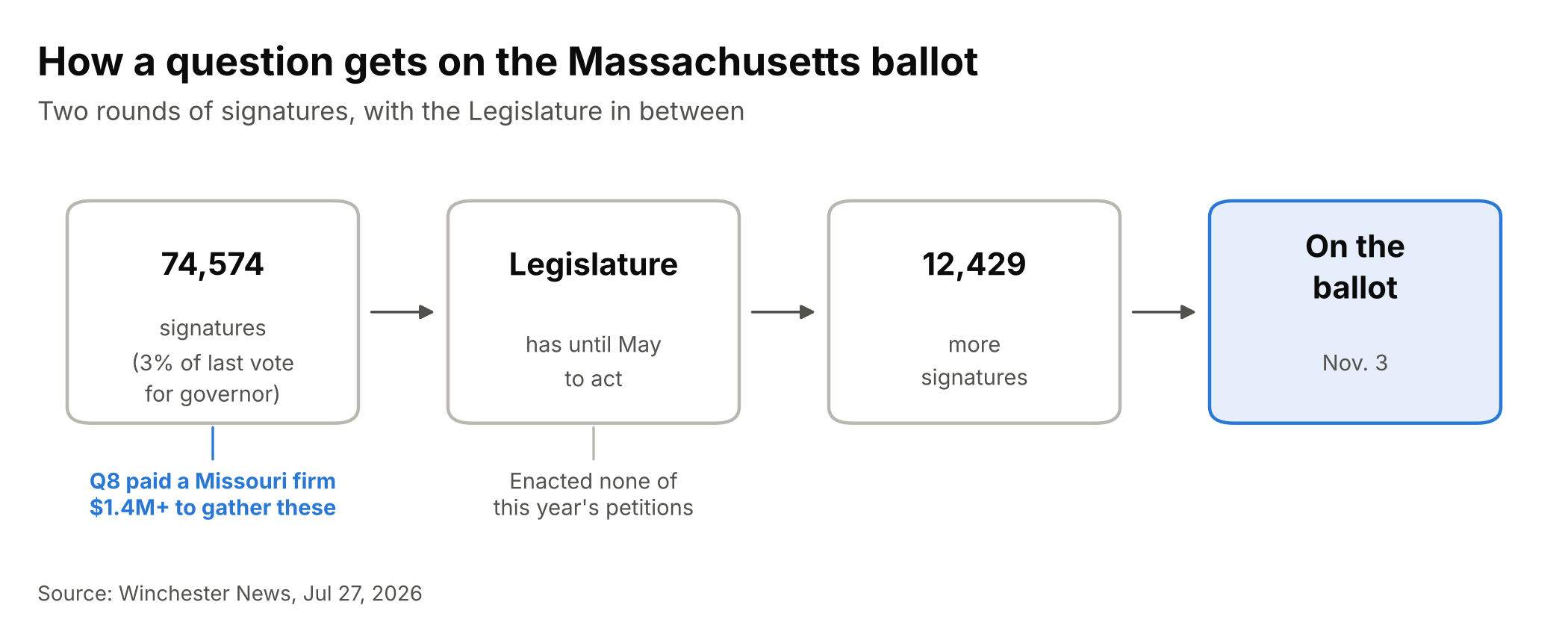
To give you an idea the campaign to repeal recreational marijuana spent more than $1.4M to a Missouri company to collect signatures.[2] Because lets be honest in a state that 65% of voters support the recreational use of weed[3] it’s going to be hard to just grab these signatures
So the first hurdle is money, what’s the second hurdle?
Question 8 is backed by the ‘Coalition for a Health Massachusetts’ (CHM). You might be thinking “I’ve never heard of this state wide group”, and that’s really because it is not state wide - it’s for all intents and purpose a Virginia based group. CHM raised $1.55M in 2025 (essentially all of its money) from ‘Smart Approaches to Marijuana Action’ a nonprofit based out of Alexandria, Virginia.[2][4] From January 2026 to end of August 2026 CHM raised $1,625,625 and about $600 came from individuals.[4]
So a question that the people of MA did not want (evidenced clearly by the donations) is now on the ballot - funded completely by out of state money.[5]
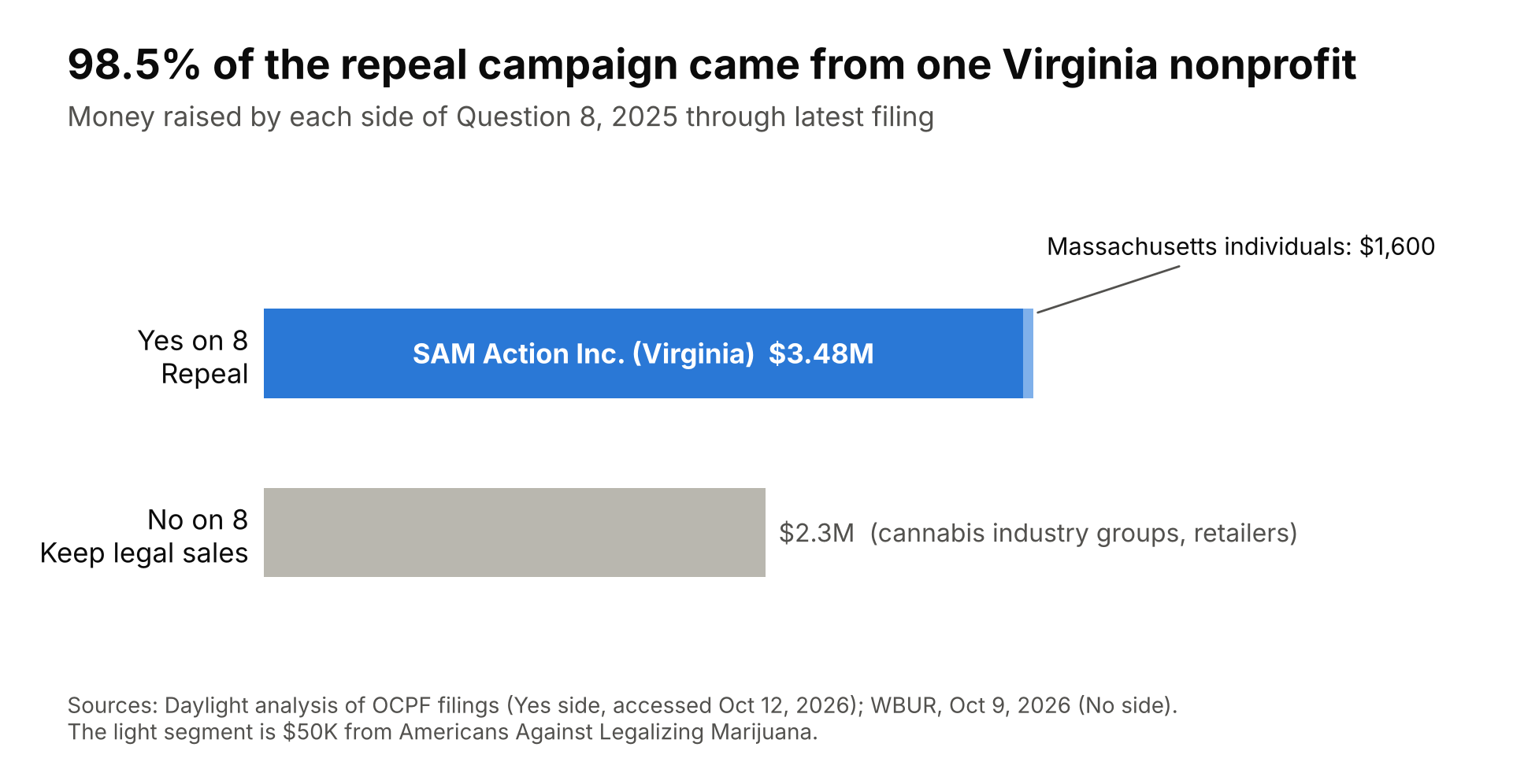
In fairness - the ‘No’ side (the ones who do not want to repeal the law) has raied a ton of money from large groups: The Committee to Protect Cannabis Regulation has raised around $2.3 million, with six-figure checks from industry groups and the Retailers Association of Massachusetts.[6]
Whilst some people say ‘there are valid concerns on the ‘yes’ side’ - such as the 4 fold increase in teen cannabis related disorders[6] - in my opinion it is fictitiously represented - the ‘Yes’ side has no interest in solving this problem but rather using kids as a prop such as the ‘pro life’ side do. They do not provide solutions that solve any problem but rather they provide an option for their stakeholders to profit.
Questions 1 and 3: the popular question and its passenger
Question 1 is the easiest ‘yes’ on the ballot. It would put the Legislature and the governor’s office under the public records law, which most people assume they already are. Supporters say MA is the only state that exempts both.[2] It polls at 84% yes.[7] Nobody has formed a committee to oppose it.[7]
Question 3 though is a different beast - it would abolish party primaries for state and congressional offices and replace them with a ‘jungle primary’ like in California where the top 2 (regardless of party) progress. It polls 51 to 32, both state parties oppose it, and so do most of the labor unions.[7]
So what links them? Both questions are backed by the same committee, the Coalition for Healthy Democracy. I ran the committee’s receipts through Daylight. It has raised $7.0 million, and just 41 donations of $50,000 or more made up 90% of it.[5] According to the Globe, David Peeler of Berkshire Partners and Andrew Balson of Cove Hill Partners each donated at least $500,000,[8] and Brian Conway of TA Associates gave at least $200,000.[5] This year the primaries campaign raised $2.9 million and, by early September, had spent $2.7 million, more than any other committee on the ballot.[8]
Compare the above to the committee State Auditor Diana DiZoglio runs for Question 1: $373,000 from 157 donors, the largest being $150,000 from her own campaign account.[5]
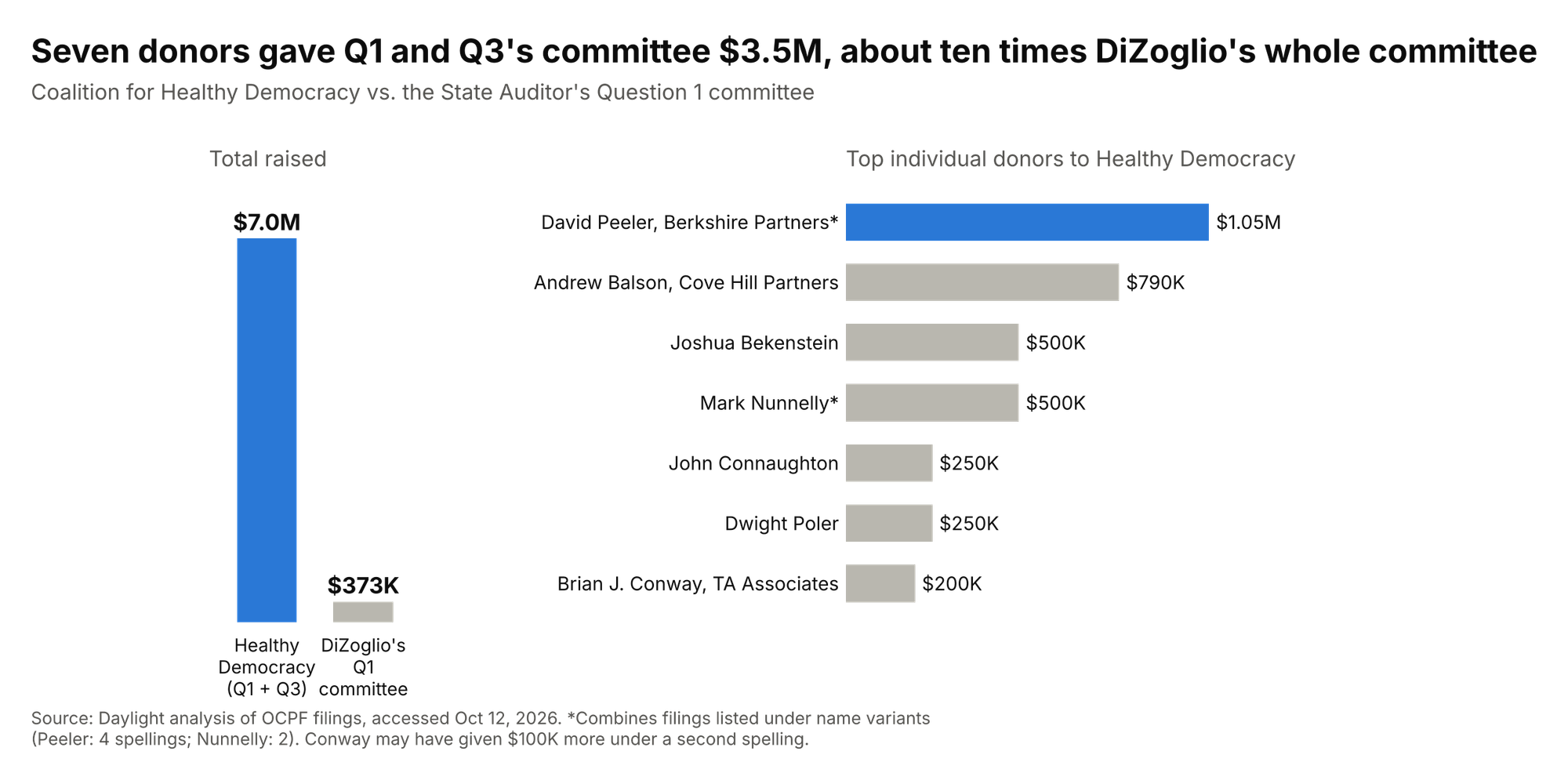
The case for Question 3 seems to be a drastic solution for a simple problem. Only 82 / 200 seats in the Legislature have a contested race this year; 116 incumbents are running unopposed.[2] This by no imagination is good for representation, but having a jungle primary where essentially money wins - is not the path forward, especially when a handful of private equity partners are the ones financing this. If the voters of MA do want this, they at least deserve to know who is financing how elections will be held as this definitely shapes the motivation of the question.
It isn’t one villain
It would be much tidier if this was a story about one Virginia nonprofit and a handful of Private Equity partners trying to shape MA. The issue is it’s not. Almost every question is infected by money
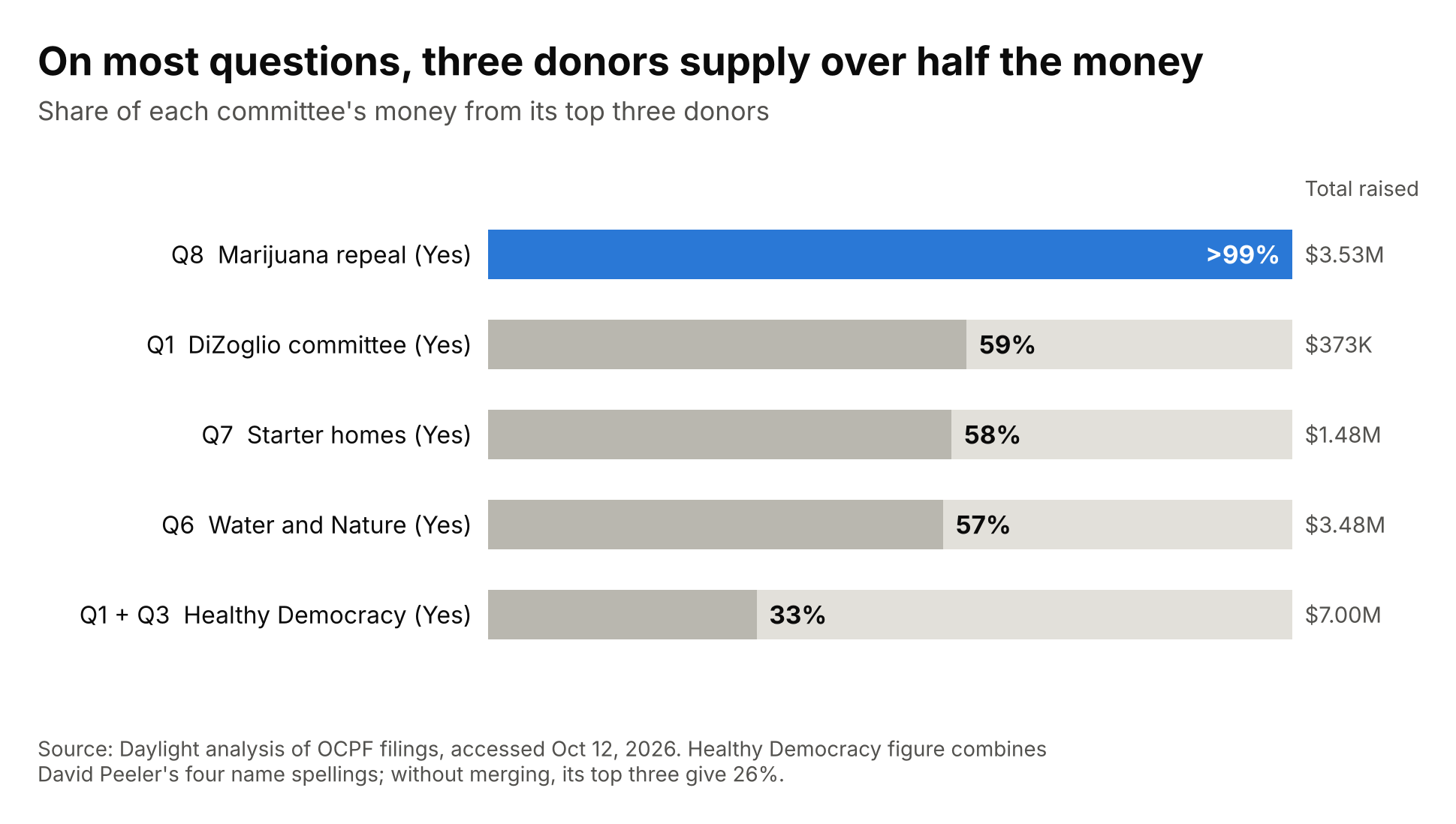
Question 6, the conservation fund the governor endorsed[8] and nobody opposes,[7] has raised $3.48 million, and just three individuals gave $1.38 million of it. One gave $800,000.[5]
Question 7, the starter-homes lot-size cap, has raised $1.48 million from 73 donors. The Greater Boston Real Estate Board and the Massachusetts Association of Realtors supplied 58% of it.[5]
Question 5, the tax-cap rewrite, is business groups against unions: about $550,000 in cash plus roughly $2 million in in-kind help from a business coalition, against $669,000 led by SEIU and the Massachusetts Teachers Association.[9] The Globe reports the business side is struggling to raise because the Senate may neuter the measure even if it passes.[9] Money follows expected returns, not causes.
Some of the questions I will be voting in favor for, some I will be voting against. That is the point - this isn’t about good vs bad questions, it is that the agenda setting power of the ballot - deciding what every voter in the state gets asked, sits with whoever can write a 6 or 7 figure check, and that is an astromically small percentage of people. So whilst the ballots may seem like representative direct democracy, like most democratic institutions in America they have been hijacked by the rich and powerful.
What unites us, and where money still wins
Here’s the “positive” part - money only buys getting the question onto the ballot, it does seem to have a lot harder time buying the actual vote. Question 8 is polling at 33% to repeal even with all of their money,[7] Question 4 - election day registration - has raised about $80,000 and the biggest donor was the Secretary of State’s[8] - and it is sits at 69%,[7] Question 1 has no oposition campaign at all and sits at 84%.[7] But, I would argue these are outliers vs the norm, which is - if you are rich you have a huge hand in shaping on what ballot measures will actually be voted on.
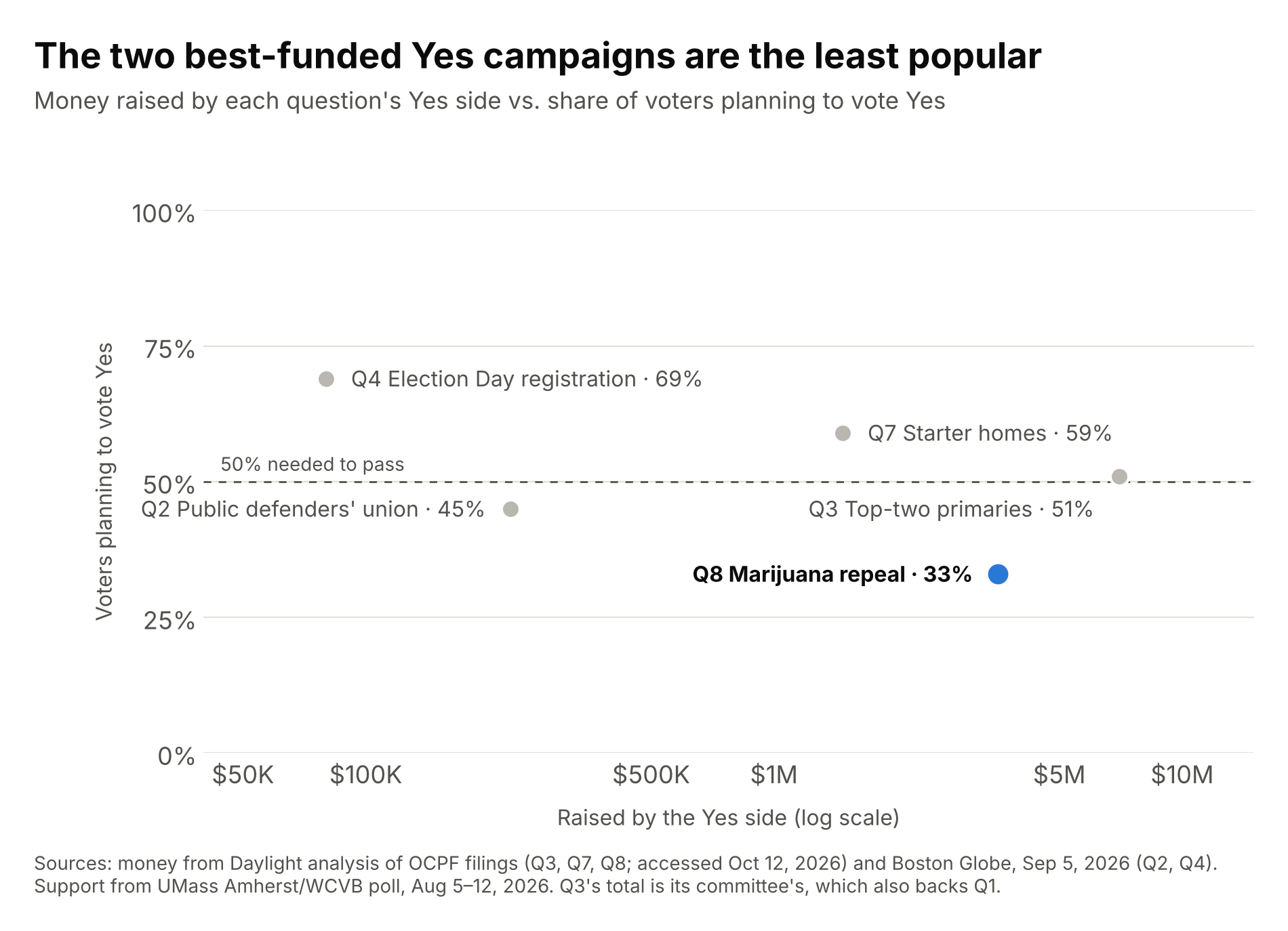
But - to be positive - the larger point is that when people seem to agree money struggles to buy a different answer. Nationally 64% of Americans support legal marijuana.[10] In MA, a decade of a working market has turned a narrow 53% win in 2016[11] into 71% opposition to undoing it.[6]
So the money goes where agreement isn’t settled yet - that is why Question 3 is the one to watch, not Question 8. At 51 / 32 with 17% still undecided,[7] it is close enough that millions of dollars on television can decide it. Question 8’s money will most likely lose but Question 3 might not.
Lastly, there’s a bigger pattern here, and it’s not unique to MA. Political scientists Martin Gilens and Benjamin Page found that once you account for what affluent Americans want, the preferences of average voters have close to no measurable effect on federal policy.[12] The ballot question is meant to be the mechanism that balances this out, but as often, in practice the mechanism opens for whoever can pay $1.4 million to collect the signatures and then fund the campaign.
Check the receipts yourself
None of this is hidden. Every dollar above was filed, dated and signed, and you can check any question in about 5 minutes.
Go to Daylight, which draws the flow of money for you.[5]
Early voting starts October 17. Read the booklet, then read the receipts.
Sources
- WBUR, report on the 2026 “Information for Voters” red book, Sep 14, 2026. https://www.wbur.org/news/2026/09/14/massachusetts-ballot-questions-red-book
- Will Dowd, “Massachusetts sets record-tying nine-question ballot for Nov. 3,” Winchester News, Jul 27, 2026. https://winchesternews.org/20260731_massachusetts-sets-record-tying-nine-question-ballot-for-nov-3/
- Western Mass News, report on the Question 8 repeal vote citing a MassINC Polling Group poll, Sep 28, 2026. https://www.westernmassnews.com/2026/09/28/massachusetts-voters-decide-whether-repeal-legal-recreational-marijuana/
- “Here’s How Much Was Raised And Spent On Both Sides Of Question 8,” Talking Joints Memo, Sep 8, 2026. https://talkingjointsmemo.com/heres-how-much-was-raised-and-spent-on-both-sides-of-question-8/
- Daylight (Read Uncut), analysis of Massachusetts Office of Campaign and Political Finance (OCPF) filings, accessed Oct 12, 2026. https://daylight.readuncut.com
- WBUR, Question 8 explainer, Oct 9, 2026. https://www.wbur.org/news/2026/10/09/massachusetts-ballot-question-8-cannabis-weed-pot-repeal
- UMass Amherst/WCVB poll, Aug 5–12, 2026 (800 registered voters, ±4.4%), as compiled in “2026 Massachusetts ballot measures,” Wikipedia. https://en.wikipedia.org/wiki/2026_Massachusetts_ballot_measures
- “Campaigns behind record-tying slate of ballot questions have raised $10m this year, with more to come,” Boston Globe, Sep 5, 2026. https://www.bostonglobe.com/2026/09/05/metro/massachusetts-ballot-questions-fundraising-november/
- “A pro-tax refund ballot question has a money problem,” Boston Globe, Sep 24, 2026. https://www.bostonglobe.com/2026/09/24/newsletters/question-5-business-leaders-donations-the-scrum/
- Gallup 2025 marijuana legalization poll, as reported by Cannabis Science and Technology, Nov 12, 2025. https://www.cannabissciencetech.com/view/gallup-poll-results-support-for-cannabis-legalization-is-high-but-not-highest
- “What to know about Mass. Ballot Question 8, which would prohibit recreational marijuana,” Boston.com, Oct 5, 2026. https://www.boston.com/news/politics/2026/10/05/massachusetts-ballot-question-8-recreational-marijuana/
- Martin Gilens and Benjamin I. Page, “Testing Theories of American Politics: Elites, Interest Groups, and Average Citizens,” Perspectives on Politics 12(3), 2014, pp. 564–581. https://doi.org/10.1017/S1537592714001595
- Secretary of the Commonwealth, “2026 Information for Voters.” https://www.sec.state.ma.us/divisions/elections/research-and-statistics/2026-Information-for-voters/main.htm