The Country That Doesn't Know Its Own Tax Rate

I've had the same conversation a dozen or more times. Someone mentions they're thinking about moving south, or they just did, and sooner or later the pitch arrives: no income tax, lower cost of living, you keep more of what you earn. It comes out like a confession of common sense, like they've figured out a trick the rest of us are too stubborn or too comfortable to act on. The South is the bastion. The Sun Belt is where your dollar stretches. Minnesota, Massachusetts, New York, those are the places you leave when you get tired of handing your paycheck to the government. Texas, Tennessee, Florida, those are the places you go when you want to keep it.
The pitch works because it confirms what people already suspect about government waste, the same suspicion that gets weaponized every budget cycle to justify gutting the systems that would actually redistribute the load.
Being a data nerd - I wanted to check whether any of that is true.
Being a data nerd I don't know how to check the 'vibes' but I do know how to check the data which is what I did.
What a family actually pays in total state and local taxes at every income level, and what they get back in life outcomes, services, and infrastructure when the paying is done.
The Institute on Taxation and Economic Policy publishes a report called "Who Pays?" that breaks this down by income bracket for every state, capturing income tax, sales tax, property tax, excise taxes, and fees. I pulled their rate tables for Minnesota, Tennessee, and Texas. Then I laid those rates next to county-level life expectancy data from the CDC, uninsured rates from the Kaiser Family Foundation, crime figures from the FBI, mobility research from Raj Chetty's lab at Harvard, and school outcomes from three state education agencies. I wanted to see what the low-tax promise looks like when you hold it up to what people actually experience.
Spoiler alert: It does not look great.
Before we dive in I just want to clarify something - I am not a statistician. I am someone who has been involved in data for 15+ years and is a PolSci major. I'm sure someone can and will disagree with what I have done and please email me at james@readuncut.com as any feedback is appreciated - it means I can improve in the future and make any necessary corrections on this piece. Anyway lets continue.
What the bottom 20% actually pays
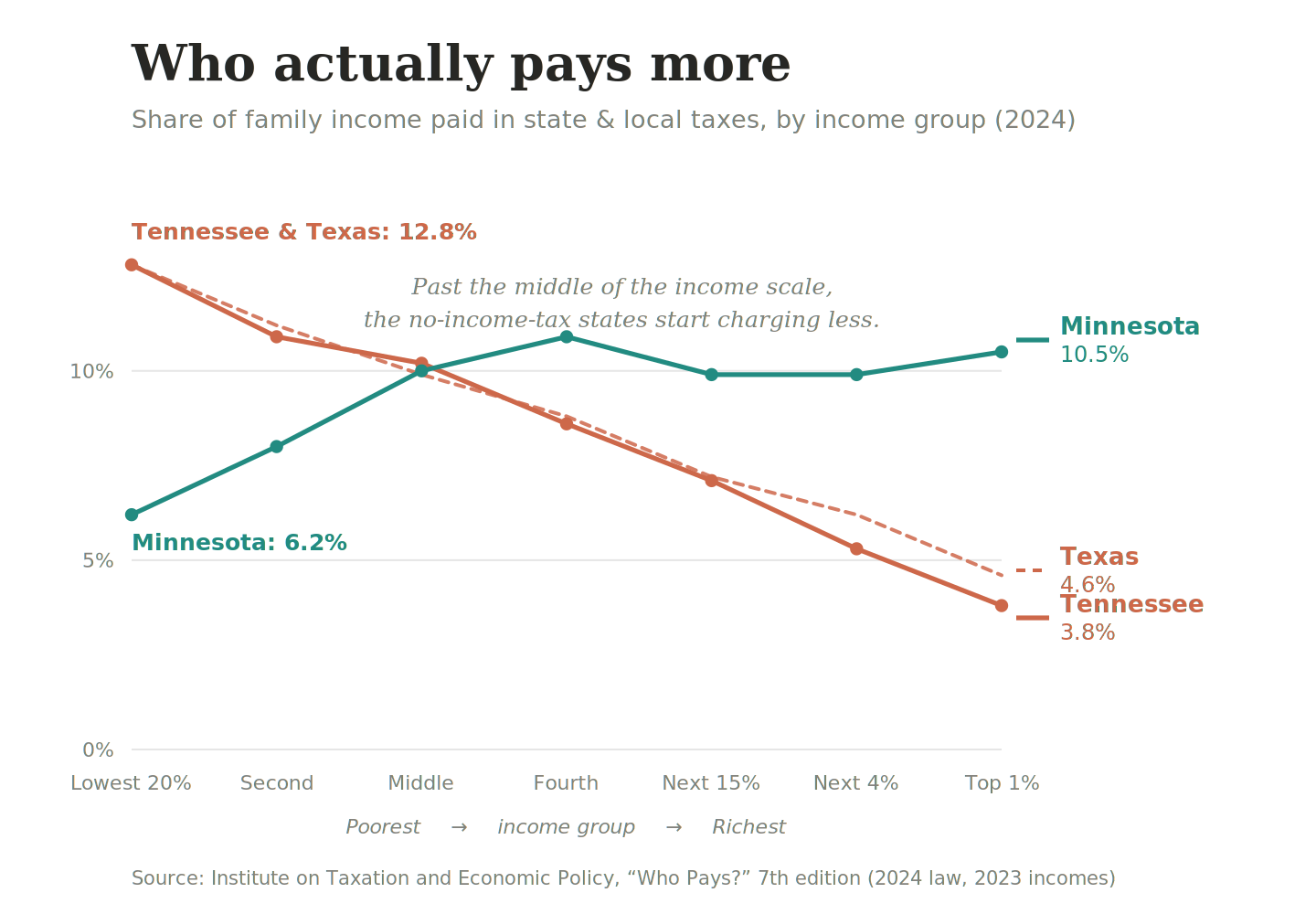
A family in the bottom quintile in Minnesota, household income under $34,400 and averaging around $19,000, pays 6.2% of their income in total state and local taxes. In Tennessee, that same bracket, income under $21,700 and averaging $12,600, pays 12.8%. Texas, same bracket, same rate: 12.8%. Those numbers include everything: income tax, sales tax, property tax, excise, fees. The family earning $12,600 in Memphis hands over a higher share of their income to the state than the family earning $19,000 in Minneapolis. More than double the rate.
The reason Minnesota's number is so low is a mechanism that can't exist without an income tax: refundable credits. The state EITC and the child tax credit flow through the income tax system and hand money back to families who earned too little to owe anything. Minnesota's bottom 20% has an effective income tax rate of negative 2%. You can't run that rebate through a sales tax. The tool that makes the system progressive is the tax that Texas and Tennessee abolished and then campaigned on having abolished.
The middle pays either way
The middle 20% is where the pitch really collapses. Tennessee's middle quintile, household income roughly $41,500 to $71,700, pays a total state and local rate of 10.2%. Minnesota's middle quintile, earning $60,800 to $100,900, pays 10.0%.
I had to check those numbers twice. A middle-income family in the state with no income tax, the state whose governors have built careers on the promise of keeping government's hands off your paycheck, pays a functionally identical rate to a middle-income family in the state that Fox News uses as a punch line for being a 'liberal expensive hell hole'.
Where the money comes from matters more than how much. Minnesota's middle quintile pays 3.6% in income tax and 3.7% in sales and excise. Tennessee's pays 0% in income tax and 7.7% in sales and excise, the same total through completely different architecture. That difference shows when someone loses a job, because income tax bends when your income drops. You earn less, you owe less. Sales tax doesn't care what happened to your job. Sales tax is flat and constant and lands on every purchase regardless of whether you got laid off last month or made partner. When a Tennessee family's income falls, the rate they pay on what's left climbs, because they're spending a larger share of a smaller income on taxable necessities. Minnesota's system has a shock absorber built in. Tennessee's has a ratchet.
Who the arrangement is actually for
There is exactly one income group for whom the low-tax story checks out, and they do not need the help.
The top 1% in Minnesota, average income $1.5 million, pays 10.5% in total state and local taxes, roughly $157,500 a year. The top 1% in Tennessee, average income $2 million, pays 3.8%. That's $76,000 on twice the income. So the millionaire in Memphis keeps an extra $80,000 a year compared to the millionaire in Minneapolis, while the family earning $12,600 in the same city covers the difference at a rate of 12.8%, more than 3x what the millionaire pays, scraped together from sales tax on groceries and gas and everything else you can't stop buying just because you're broke.
Minnesota's bottom-to-top ratio is 0.59 to 1. The bottom quintile pays a lower rate than the top. In Tennessee, 3.37 to 1. The poorest families pay more than three times the rate of the richest, in a state that has built its brand on going easy on working people. Tennessee is the 3rd most regressive tax system in the country. Minnesota is the 2nd least regressive. Two entirely different answers to the question of who should fund the roads and the schools and the hospitals, and only one of those answers has the decency to charge people in proportion to what they have.
What the money buys
When I started looking at outcomes, I expected (more hoped) the gap to be real but modest. And if you were wondering if there is another spoiler alert....: it's even worse than I had anticipated.
A baby born in Shelby County, Memphis, will live to about 72. A baby born in Hennepin County, Minneapolis, will live to about 79. 7 years, opened at birth, as if the county line were a customs checkpoint between two countries - one a third world at war, one a developed nation during peacetime. Infant mortality in Shelby County is 9 per 1,000 live births; Minnesota's statewide rate is 4.0. Drug overdose deaths in Memphis hit 50 per 100,000 against a national average of 28.2. I have even more statistics I can provide (please check the Sources below) but honestly it gets too depressing.
Tennessee refused to expand Medicaid, and the gap shows in every coverage number. Uninsured rates run 4 to 6% in Hennepin County, 11 to 13% in Shelby, and 22.2% in Harris County, Houston, where more than one in five residents have no health coverage at all.
Memphis has a violent crime rate of 2,501 per 100,000, the highest of any large American city, against Minnesota's state average of 257. A child born poor in Memphis has roughly half the probability of reaching the middle class compared to a child born poor in Minneapolis. Chetty's research pins upward mobility to five factors, from school quality to family stability, and Memphis scores badly on all of them, which is another way of saying the state saved money on every system that would have changed those numbers.
The same forces that collapse mobility in Memphis are eating American cities from the inside, a pattern of extraction dressed up as fiscal responsibility that leaves entire generations worse off than their parents while the top pulls further away.
Minneapolis ranks 3rd nationally in the Trust for Public Land's ParkScore index, with 99% of residents within a 10-minute walk of a park. Houston ranks 56th. Memphis doesn't crack the top 100.
The taxes nobody calls taxes
This is the part that I think people genuinely miss, and I don't blame them, because it's designed to be missed.
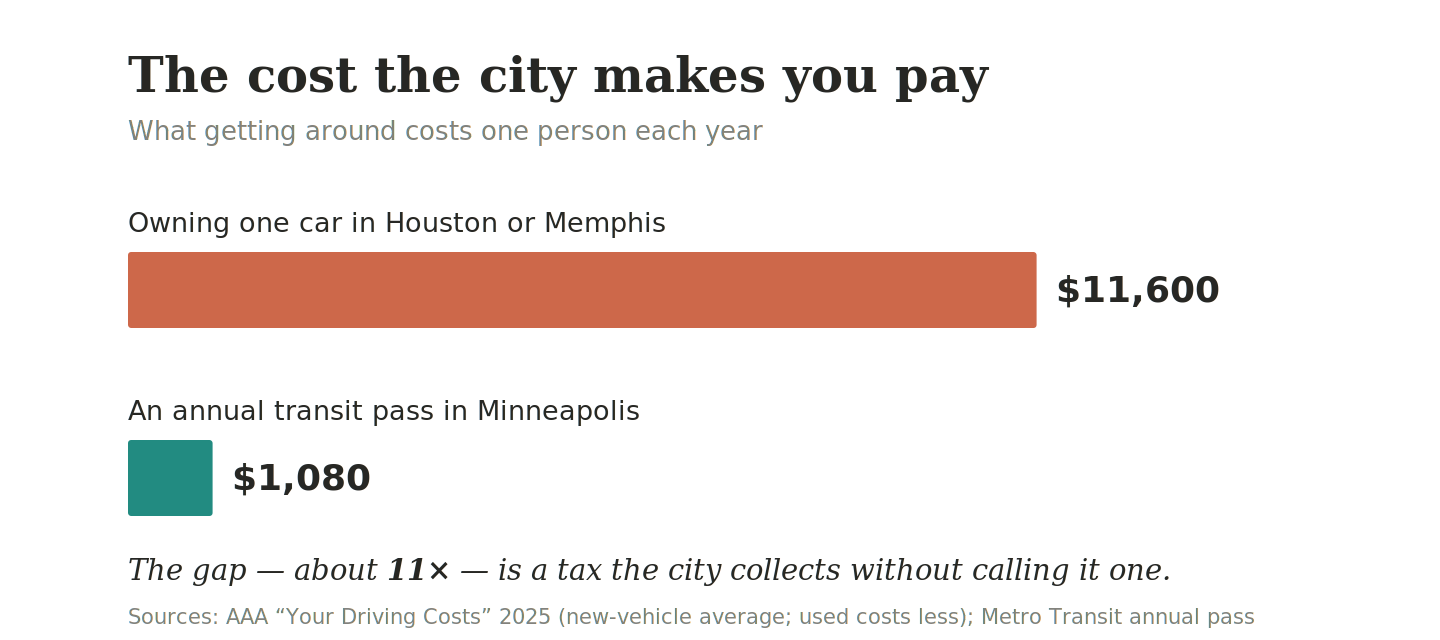
Houston and Memphis are functionally car-dependent cities. Memphis runs buses and nothing else; under 2% of commuters use transit. The annual cost of owning and operating a car in the US runs $10,000 to $12,000. Two cars: $20,000 to $24,000. A Minneapolis resident in the urban core can use Metro Transit for $108 a month, $1,296 a year. The gap between $1,296 and $23,000 is a essentially a compulsory payment extracted by the design of the city, falling hardest on the people earning the least, invisible in every tax comparison ever published because the check ends up at a dealership and an insurance company instead of the government.
Austin proved you could fix this without waiting for federal intervention, bringing rents down 19% while other cities studied the playbook and then filed it away, because the real barrier was never technical but political.
In Minnesota, MinnesotaCare and expanded Medicaid catch you when you lose employer coverage. In Texas and Tennessee, nothing catches you. The income tax you "saved" becomes the bill you owe the emergency room or any other social security you may need.
The trick
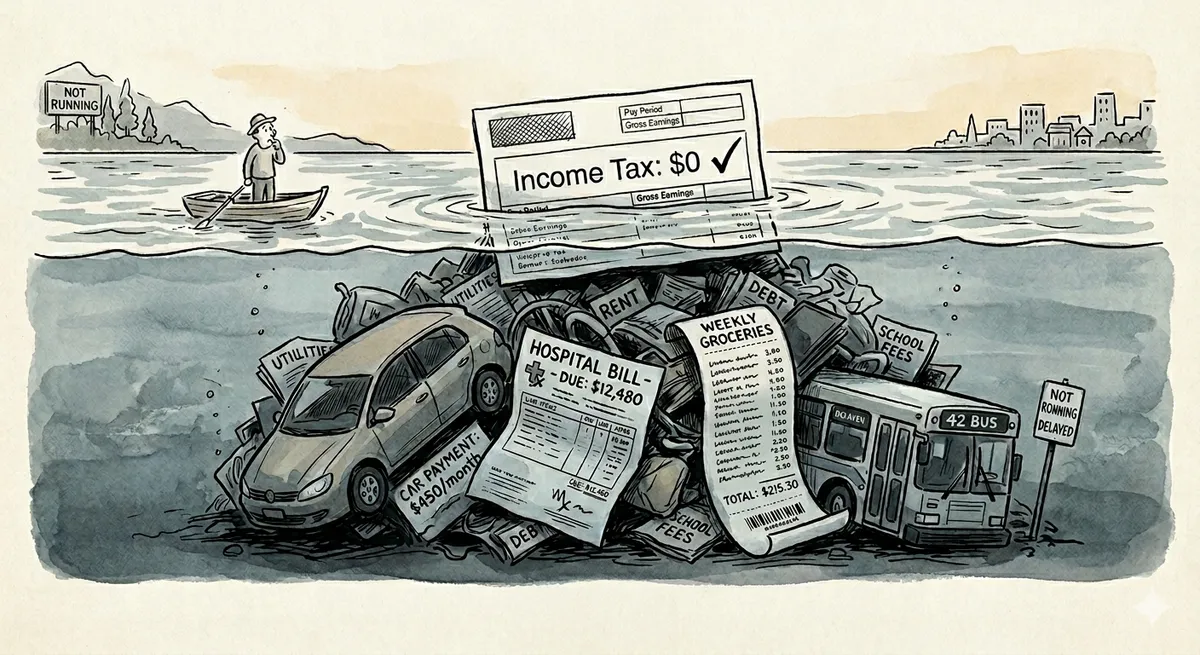
The entire arrangement survives on a single cognitive error: people feel the taxes they can see and do not feel the ones they can't. An income tax is visible, a line on your pay stub, a number on your return, a percentage a governor can point to and promise to cut. Sales tax disappears into every transaction in increments too small to track. Property tax gets folded into mortgage payments. Car costs are just what it costs to live here, and healthcare is what it is. Nobody adds them up and actually thinks about them.
The same misdirection runs through every major policy debate in America, from AI regulation to tax reform, a deliberate effort to keep the public focused on the wrong metric while the people writing the rules optimize for a completely different outcome.
So a governor stands at a podium and says "we don't tax income," and the crowd cheers, and nobody in that crowd has calculated that their combined sales tax and property tax and car insurance and health premiums add up to more than they'd pay in Minneapolis, where the government would also send them a refundable credit and a bus pass and a park within walking distance and a doctor who takes their coverage.
I don't think most people who repeat the low-tax pitch are lying. I think they genuinely believe it. The brochure is convincing and the income tax line on their pay stub really did disappear. But Minnesota charges more in taxes than either state and delivers more for it, by every measure the government tracks. Its residents live six to seven years longer than Memphis residents at the county level. Their children are twice as likely to escape poverty and their healthcare system doesn't leave one in five residents uninsured. The difference is Minnisota asks residents who have more to pay more, whilst Texas and Tennesse ask the rich to pay less and the poor to cover the gap.
The tax hasn't been eliminated but rather it has been privatized
Almost nobody in Memphis is saving money. They're paying less to the government and more on life from cars to food to transport to health. The tax hasn't been eliminated but rather it has been privatized, made invisible, and made more expensive, and the people who benefit from the arrangement, the top 1%, have every reason to keep the bumper sticker in circulation and the arithmetic out of the conversation.
Sources
- Institute on Taxation and Economic Policy, "Who Pays?" 7th Edition — Minnesota, Tennessee, and Texas state pages
- U.S. Census Bureau, American Community Survey (ACS) 2024 1-Year Estimates
- CDC National Vital Statistics Reports, State Life Tables 2022–2023
- CDC County Health Rankings (via HealthByCounty.com and Smart City Memphis)
- Kaiser Family Foundation, state uninsured rate data
- SHADAC (State Health Access Data Assistance Center), uninsured rate estimates
- FBI Uniform Crime Report 2024 (via WREG, The Hill, USAFacts)
- Raj Chetty / Opportunity Insights, Harvard University — upward mobility data
- Trust for Public Land, ParkScore Index 2025
- USAFacts, state and county life expectancy and crime data citing CDC and FBI
- Minnesota Department of Health, infant mortality data
- University of Memphis, Poverty Fact Sheet 2024
- Avalara, Tennessee sales tax rate data (state and local breakdowns)
- TaxJar, Tennessee grocery tax rate verification
- TaxCloud, Tennessee grocery tax rate verification
- SalesTaxHandbook, Memphis combined sales tax rate
- AARP, state grocery tax comparison
- Bankrate, Minnesota sales tax rate data
- Tax Foundation, state and local sales tax rate data
- Data USA, ACS 2024 county-level income, property values, and homeownership
- Census Reporter, ACS 2024 1-Year Estimates (Minneapolis income)
- MN Demographics Center, 2024 population and income data
- World Population Review, city-level median income and poverty rates
- city-data.com, Houston median income and poverty data
- Point2Homes, Memphis median household income
- usdataexplorer, Shelby County income and life expectancy (ACS 2024)
- National Center for Education Statistics (NCES), per-pupil spending data
- Memphis-Shelby County Schools (MSCS), press release October 2024 — graduation and proficiency rates
- Texas Tribune, Houston ISD enrollment, graduation rate, and TEA rating
- Houston Public Media, Houston ISD state takeover reporting
- Community Impact, Houston ISD TEA accountability rating
- MN Reformer, Minneapolis chronic absenteeism data
- Minnesota Department of Education, attendance and proficiency data
- Every Texan (formerly Center for Public Policy Priorities), Texas ITEP tax rate analysis
- Mahadevmaitri (citing NCES and Chetty-derived data), Memphis per-pupil spending and opportunity score