The AI Bet Corporate America Actually Made (It Wasn't Productivity)
AI gave corporate America a way to gut headcount and get applauded for it. An NBER study found only 2% of execs attributed cuts to actual AI, but 60% cut in anticipation of efficiencies that haven't arrived. The bet was never productivity. It was permanent wage compression with better PR.

Labor is the most expensive thing a company buys, more expensive than the cloud infrastructure, more expensive than the office space, more expensive than the espresso machine nobody asked for but the CFO approved because morale was circling the drain and a Breville seemed cheaper than addressing why. Salaries, benefits, equity, payroll taxes, the management layers required to organize the salaries, the HR departments required to manage the management layers, all of it stacking up until the line item that represents the people who actually do the work typically accounts for somewhere between 40 and 60 percent of a services company's revenue, which means that every CFO in the country is looking at a P&L where the single largest controllable cost has a pulse and opinions and a LinkedIn profile that's been suspiciously active lately.
Every other major expense is either locked in by contract or set by a market the company can't push around, but labor is the one item where a unilateral decision by management can move the number overnight, and the market has always loved a company that found a way to keep the revenue and lose the humans, the way a restaurant would love a kitchen that cooked the food without needing to employ chefs. Companies have wanted cheaper labor since the first factory owner looked at a wage bill and felt his chest tighten. What happened in the space of about eighteen months is that companies found a story that lets them do it at scale, across every industry, all at once, and get applauded for it instead of questioned.
The Two Doors
In 1970, the economist Albert Hirschman published a slim, quietly devastating book called Exit, Voice, and Loyalty that asked what keeps powerful institutions from treating people badly. His answer came down to two mechanisms that operate like pressure valves in a boiler, the kind of thing you don't notice until they stop working. People can exit, meaning they leave for the competitor who pays better or treats them less like furniture. Or they can use voice, meaning they stay but push back, organize, make enough noise that ignoring them becomes more expensive than listening, the way a squeaky hinge gets oiled not because anyone cares about the hinge but because the sound has become intolerable.
As long as either valve is open, the institution faces a cost for squeezing too hard. Hirschman noticed that when both close at the same time, people don't revolt, they comply. He called it loyalty, though the word flatters the dynamic considerably, like calling a hostage situation a sleepover. It is the behavior of people who have checked both exits and found them bricked shut, and who then accept whatever terms they're given and hope the next round of cuts lands on someone else's desk.
What AI did, in the space of roughly two years, was brick shut both doors simultaneously, across nearly every white-collar industry, in a way that no previous technology or management fad ever managed. And it did this before the technology even needed to work, which is the part that should bother you more than anything else in this piece.
The Prestige Cut
Companies have always wanted to cut headcount aggressively, the way a dog has always wanted whatever is on the counter, and what kept them from lunging was not capability but consequence. Before AI, a CEO who announced a 20 percent workforce reduction was "restructuring," a word that signals distress the way a hospital gown signals that something has already gone wrong, a company admitting it had hired too many people, grown too fast, misjudged a market, cleaning up its own mess while everyone watched.
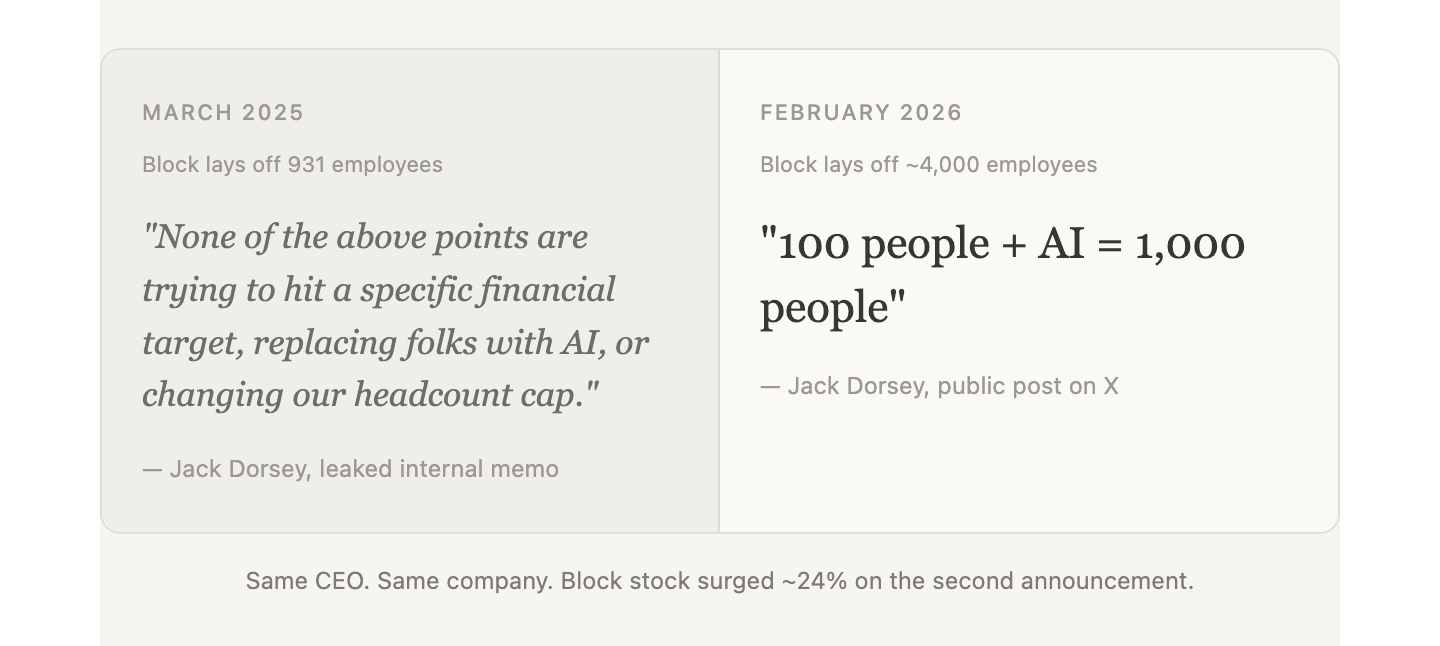
A CEO who cuts 20 percent of the workforce in 2026 is doing something that looks identical on a spreadsheet but carries the opposite story: they are "transforming," leaning into the future, the sort of thing that earns you a keynote slot rather than a shareholder lawsuit. Block's Jack Dorsey demonstrated both versions with the poise of a man who had already forgotten what he said twelve months ago. In March 2025 he laid off 931 people and wrote, in a memo that leaked to TechCrunch, that the cuts were not about AI, not about hitting a financial target, just a standard reorg, nothing to see. Eleven months later he cut roughly half the remaining workforce, around 4,000 people, posted "100 people + AI = 1,000 people" on X with the confidence of a man who has never been asked a follow-up question, and told investors that intelligence tools had changed what it means to run a company. Block's stock surged about 25 percent on the announcement. Same CEO, same company, opposite explanations, and the difference was not a breakthrough in technology but that by early 2026 the AI narrative had matured to the point where attributing layoffs to it was a signal of conviction rather than an admission of failure. Meta confirmed this week that it will cut 10 percent of its workforce, around 8,000 employees, while spending up to $135 billion on AI infrastructure, and the market's response to simultaneously firing thousands of people and spending the GDP of a mid-sized country on data centers was to nod approvingly.
Self-checkout was always understood as a cost play, and offshoring was politically toxic from the jump, but AI is the first labor-cost reduction strategy that makes the person swinging the axe look like a visionary rather than an accountant, and that reputational alchemy is worth billions in market capitalization because it converts the shame of firing people into the prestige of having a plan.
Everyone At Once
The prestige narrative would not be enough on its own, because the labor market used to punish employers who cut unilaterally, since the best people would simply walk to a competitor still hiring, and the company that overreached spent the next three years trying to recruit in a market that remembered what it did and charged accordingly.
AI dissolved that brake by creating simultaneous permission across the entire economy. When every major employer is telling the same AI story on the same earnings calls in the same quarter, the exits close for workers not because any single employer sealed them but because thousands of companies running the same playbook at the same time leaves nowhere to walk to, like every pub on the street raising its prices on the same afternoon and then marveling at how cooperative the customers have become. You cannot leave Meta for Google if Google is running the same playbook, and you cannot pivot from finance to tech if both sectors are shedding headcount while their executives give identical interviews about smaller teams doing more with less, a phrase repeated so often it has started to function less like a strategy and more like a password, the thing you say to signal membership in the club of people who have decided that headcount is a problem to be solved rather than a workforce to be led.
A CEOWORLD magazine survey of 125,000 business leaders found that 54 percent of companies have already reduced or plan to reduce employee compensation in 2026 to fund AI initiatives, reaching into bonuses, equity, raises, and base pay, and that 88 percent of the leaders making those cuts said the weak job market makes it easier to reduce compensation without losing talent, which is the kind of confession that in a previous century might have been whispered behind a closed door but which 88 percent of 125,000 executives apparently felt comfortable saying on the record, to a survey, with the breezy confidence of people who know that nobody with the authority to do anything about it is paying attention.
The coordination requires no conspiracy, which is part of what makes it so durable, because it produces all the wage-suppressive effects of a cartel without any of the liability, compounding like interest on a debt the workers never agreed to take on.
The gendered version of this is even starker, because the same group that was overrepresented in every round of cuts is now being scored on the AI-usage metric they were least encouraged to adopt.
Permanent by Assertion
Previous rounds of cost-cutting always carried an implicit promise that the pain was cyclical, that companies cut during downturns and rehired during recoveries, and that anyone who survived could expect the market to swing back the way a tide comes in even after it goes out.
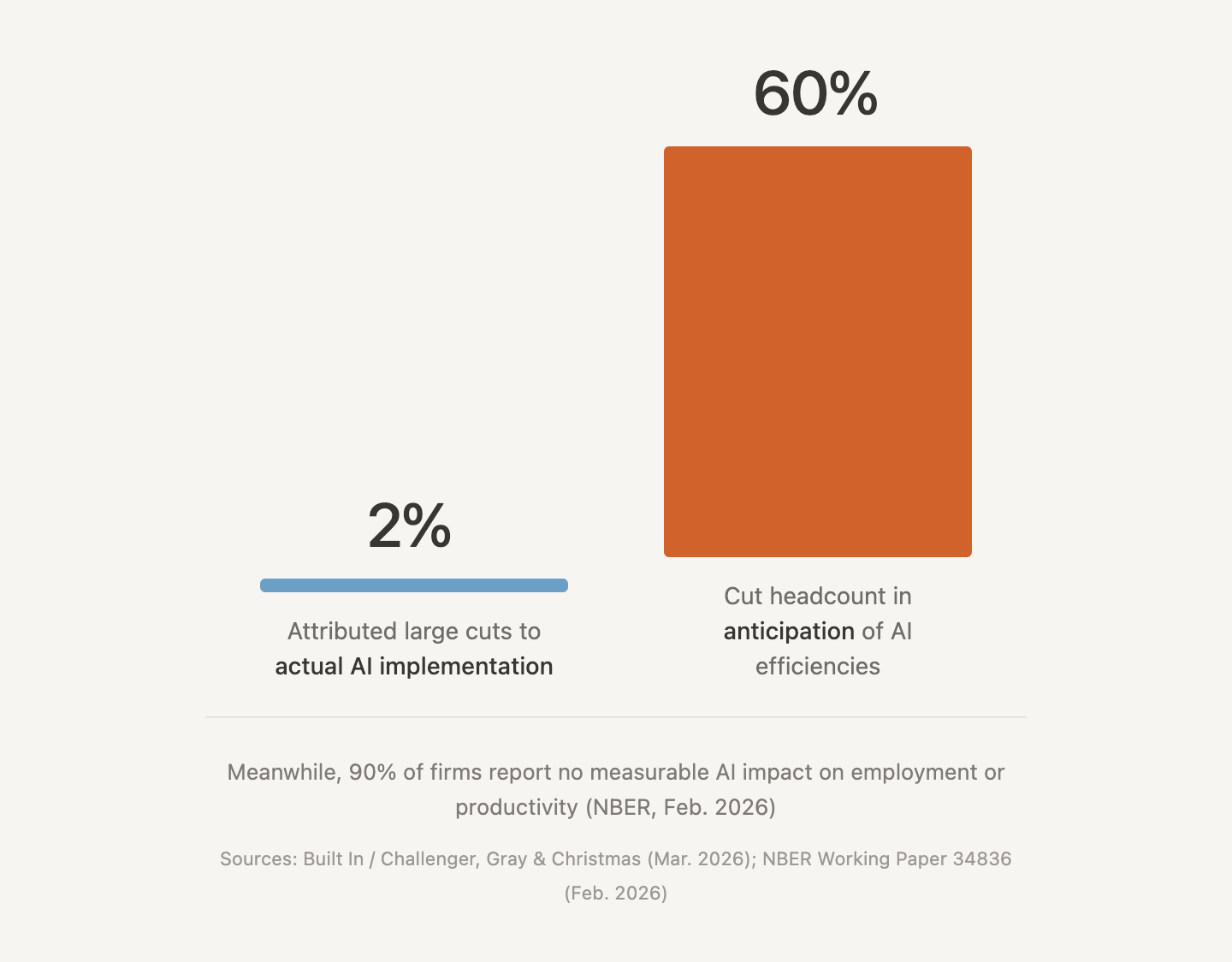
AI rewrote those terms by framing the cuts as structural and irreversible, the narrative equivalent of a company announcing that the concept of stores is over while boarding up the windows and salting the earth outside. The message is that these roles are permanently obsolete, absorbed by systems that do not take holidays or ask for raises or develop inconvenient opinions about management, a claim that carries the confidence of a doctor's diagnosis and roughly the evidentiary basis of a horoscope. A February 2026 NBER study of 6,000 executives across four countries found that the vast majority reported little measurable impact from AI on their operations. Built In reported that only 2 percent of executives attributed large staff reductions to actual AI implementation, a number so small you could seat it at a single restaurant table, but 60 percent said they had made cuts in anticipation of efficiencies that haven't arrived, which is the corporate equivalent of selling your car because you heard there might be a train coming, sometime, possibly to a station that doesn't exist yet. A forecast, it turns out, suppresses your wage just as effectively as the real thing, because your salary is negotiated in the present tense and the future is whatever the person across the table says it is.
(The technology itself has fundamental limitations that the hype cycle quietly skips over, but the wage impact does not require the technology to work, only the story.)
I wrote about the productivity data in more detail previously, the MIT finding that 95% of AI pilots deliver no measurable P&L impact, the Klarna reversal, the gap between the narrative and the numbers.
You negotiate differently when you believe the downturn will end than when you believe your occupation is being erased, and when the story is that your job category is being automated out of existence, you take whatever is on the table, the lower salary, the reduced equity, the increased workload, because the alternative isn't waiting for a better offer but watching your entire profession get fed into a wood chipper while a man in a fleece vest calls it progress. That is Hirschman's captive loyalty, powered not by a machine that can do your job but by a story that says one is being built.
Where The Money Went
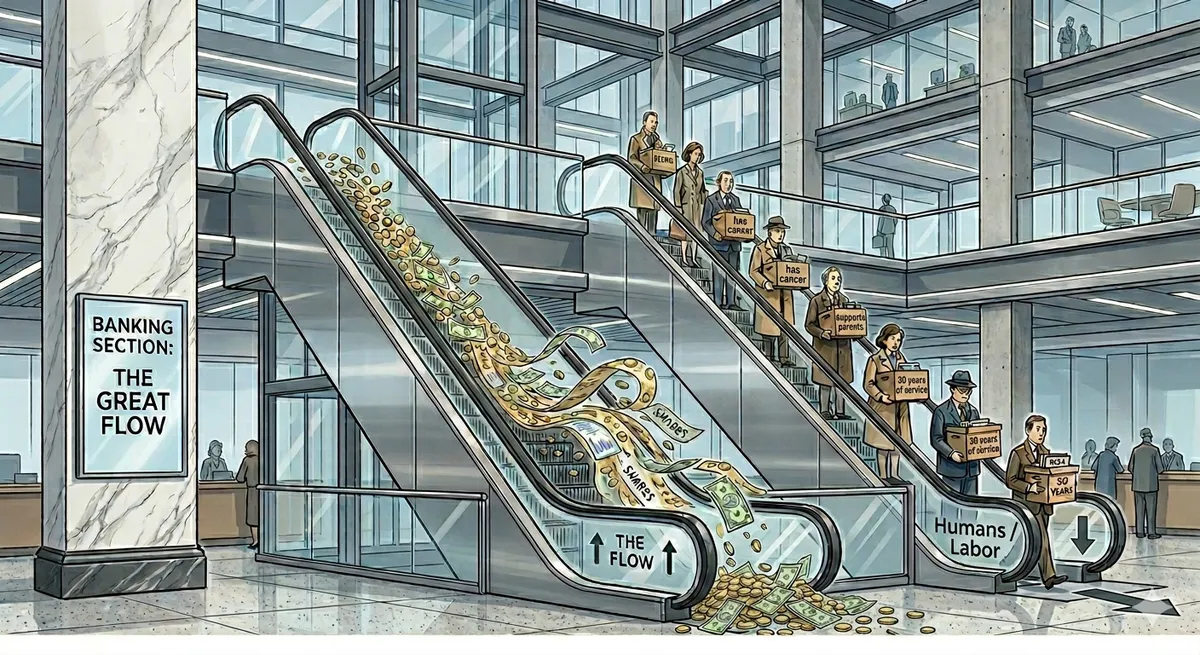
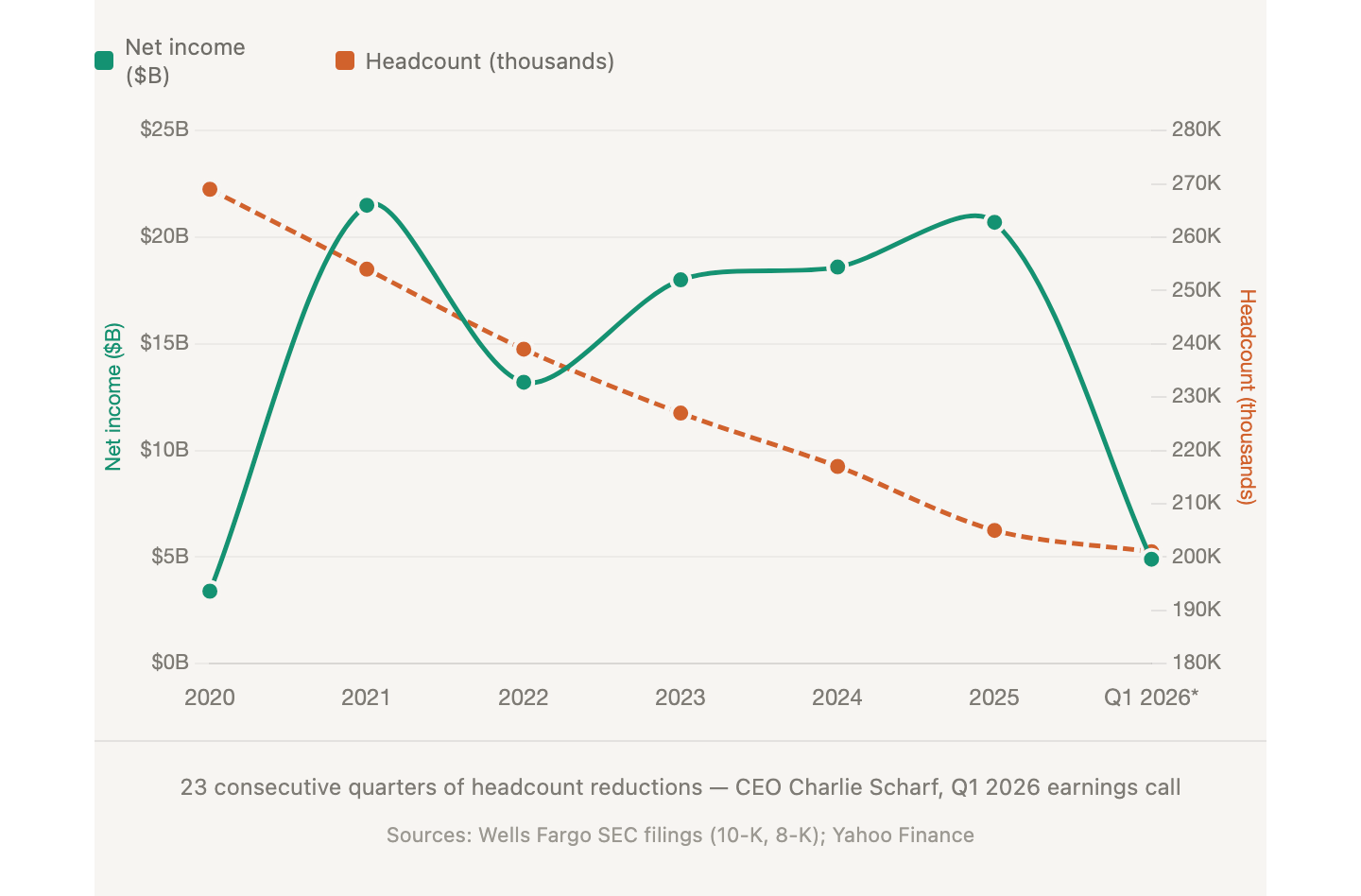
The six largest U.S. banks posted a combined $47.3 billion in net income in Q1 2026, up 18 percent year-on-year, while collectively cutting thousands of positions, a pattern of record profits marching upward in lockstep with headcount marching down, like two escalators in a department store running in opposite directions with the money riding one and the people sliding off the other. Bank of America CEO Brian Moynihan described the process as letting headcount "drift down," and it is worth pausing on that verb, because "drift" is the kind of word you use for clouds and autumn leaves, not for the deliberate elimination of a thousand people's livelihoods, but the euphemism does its job beautifully, making a boardroom decision sound like weather, blameless and inevitable. Wells Fargo has now reduced headcount for 23 consecutive quarters while posting record profits, treating the whole project as the future arriving on schedule rather than evidence that someone decided the future would have fewer people in it.
If AI were genuinely delivering the productivity gains the earnings calls describe, the rational response would be to expand, the way a printer who suddenly doubled their output would print more books, not fewer. Instead the savings are going where they always go, buybacks, dividends, margin expansion, the executive compensation packages that somehow manage to grow in the same years the headcount shrinks, a magic trick that never gets old because nobody in the audience is allowed to ask how it works.
What Gets Locked In
Every job eliminated and attributed to AI resets the market expectation for that function, the way a house that sells at a loss resets the comps for the whole street. Every company that announces it can operate with fewer people pulls the salary band down across the industry, because recruiters read the same headlines and hiring managers adjust accordingly. The workers still in that category negotiate against a smaller market with fewer openings, and their bargaining power drops whether or not an AI system is actually doing the work that used to be theirs, because the labor market has always run on narrative as much as reality, and the narrative right now is that you are expensive and the machine is cheap and patient and does not have a family that needs health insurance.
The workers who remain adjust their behavior accordingly, pushback dries up, compliance replaces conviction, and the company loses the internal friction that used to catch bad decisions before they became expensive ones.
A previous piece on this site traced how American wages decoupled from productivity in 1979 and never reconnected, pulled apart by union erosion, deregulation, tax policy that flowed upward like heat in a badly insulated building, and globalization, forces that took forty years to hollow out blue-collar bargaining power, slowly enough that each loss could be explained away as a local misfortune rather than a national project. AI is extending that pattern into white-collar work, into the last cohort of workers who still had enough weight to demand a share and who mostly spent it arguing about stock options instead of organizing, and it is moving at earnings-call speed, which means the transfer that took a generation in manufacturing is happening to knowledge workers in a couple of fiscal years, most of them still debating whether the chatbot can write code while their employment terms are quietly rewritten around them, like a lease amended while the tenant is asleep.
The productivity might come eventually. The wage compression is already here, already baked into salary bands and hiring freezes and the quiet decisions of a thousand HR departments reading the same CEOWORLD survey and drawing the same conclusion. Four decades of offshoring, deregulation, and automation promised the same thing, that the pain was temporary, that the gains would find their way down, and every time the gains found their way down they seemed to stop one floor above the people who were promised them, like a lift that works perfectly for everyone except the ground floor, and at some point you stop believing the lift is broken and start wondering whether it was built that way.
Sources
Labor cost data
- U.S. Bureau of Labor Statistics, "Employer Costs for Employee Compensation," December 2025. https://www.bls.gov/news.release/pdf/ecec.pdf
- Paycor, "The Biggest Cost of Doing Business: A Closer Look at Labor Costs," January 2026. Notes BLS data showing labor costs can account for up to 70% of total business costs. https://www.paycor.com/resource-center/articles/closer-look-at-labor-costs/
- Rippling, "What Percentage of Revenue Should Go to Payroll By Industry," November 2025. Service industries 40-60%, manufacturing 15-30%. https://www.rippling.com/blog/payroll-as-a-percentage-of-revenue-by-industry
Albert Hirschman
- Hirschman, Albert O. Exit, Voice, and Loyalty: Responses to Decline in Firms, Organizations, and States. Harvard University Press, 1970.
Block / Jack Dorsey
- Dorsey, Jack. Layoff memo, March 2025 (leaked to TechCrunch). Stated cuts were "not about... replacing folks with AI, or changing our headcount cap." Covered in Gil Pignol, "Block's Layoffs Reveal the Great AI-Washing of Corporate America," Medium, March 1, 2026. https://medium.com/@gp2030/blocks-layoffs-reveal-the-great-ai-washing-of-corporate-america-db30b4c21ceb
- Dorsey, Jack. Employee letter and X post, February 27, 2026. Declared "100 people + AI = 1,000 people" and attributed approximately 40% workforce reduction to intelligence tools. Covered in Newsweek, February 27, 2026. https://www.newsweek.com/read-jack-dorseys-full-statement-block-layoffs-11590862
- Storyboard18, "Is AI the reason for Block CEO Jack Dorsey's 4,000 layoffs?" March 12, 2026. Block stock rose roughly 25% on the announcement. Block headcount ballooned from 4,000 (end 2019) to nearly 13,000 (end 2023), per WSJ. https://www.storyboard18.com/brand-makers/block-inc-layoffs-ai-shift-or-ai-washing-behind-jack-dorseys-4000-job-cuts-91644.htm
- Futurism, "Jack Dorsey Isn't Telling the Real Story About Block's AI Layoffs, Insider Says," March 5, 2026. https://futurism.com/artificial-intelligence/jack-dorsey-block-ai-layoffs-insider
Meta layoffs and capex
- Meta Platforms, internal memo to employees, April 23, 2026. Confirmed 10% workforce reduction (approximately 8,000 employees) effective May 20, plus cancellation of 6,000 open roles. Covered in TechCrunch, April 23, 2026. https://techcrunch.com/2026/04/23/meta-job-cuts-10-percent-8000-employees/
- CNN Business, "Meta to cut 10% of staff as it pours billions into AI," April 23, 2026. https://www.cnn.com/2026/04/23/tech/meta-layoffs-10-percent-staff-ai
- Meta 2026 capital expenditure guidance of $115-135 billion. CNBC, "Tech AI spending approaches $700 billion in 2026," February 6, 2026. https://www.cnbc.com/2026/02/06/google-microsoft-meta-amazon-ai-cash.html
- Reuters, March 2026, originally reported Meta was weighing cuts affecting up to 20% of workforce. Covered in Entrepreneur, March 16, 2026. https://www.entrepreneur.com/business-news/meta-planning-layoffs-affecting-16000-jobs-20-workforce
Wall Street bank profits and job cuts
- Bloomberg, "Wall Street Banks Cut 5,000 Jobs Even as They Notched Record Profits," April 15, 2026. Six largest U.S. banks posted $47.3 billion in Q1 2026 net income. Four of six reduced headcount; Wells Fargo led with 4,000+ cuts. JPMorgan and Morgan Stanley added staff. Net reduction approximately 5,000. https://www.bloomberg.com/news/articles/2026-04-15/wall-street-banks-cut-5-000-jobs-even-as-they-notched-record-profits
- New York Times reporting (cited in secondary sources including 4 Corner Resources, April 2026) gives a broader figure of 15,000 including reductions beyond net headcount. https://www.4cornerresources.com/job-market-news/wall-street-ai-job-cuts-2026/
- Bank of America CEO Brian Moynihan, Q1 2026 earnings call. Described letting headcount "drift down" and credited AI with savings equivalent to roughly 2,000 coding positions. Covered in Technocracy News, April 22, 2026. https://www.technocracy.news/how-ai-is-forcing-headcount-reductions/
- Wells Fargo CEO Charlie Scharf, Q1 2026 earnings call. Cited 23 consecutive quarters of headcount reductions alongside AI investment. Covered in Bloomberg via Union Leader, April 19, 2026. https://www.unionleader.com/wall-street-banks-cut-5-000-jobs-even-as-they-notched-record-profits/
Compensation cuts and anticipatory layoffs
- CEOWORLD magazine survey of 125,000 U.S. business leaders, March 2026. 54% of companies have reduced or plan to reduce employee compensation in 2026 to fund AI. 88% of leaders making cuts cited the weak job market as enabling reductions. https://ceoworld.biz/2026/03/16/report-bonuses-equity-raises-what-companies-are-willing-to-sacrifice-to-scale-ai/
- Built In, "Did AI Take Your Job? The Truth About AI Washing," March 2, 2026. 2% of executives attributed large staff reductions to actual AI implementation; 60% made cuts in anticipation of AI efficiencies. Challenger, Gray & Christmas data: AI cited in 55,000 of 1.2 million job cuts in 2025 (4.5%). https://builtin.com/articles/ai-washing-layoffs
- NBER study (February 2026) of approximately 6,000 CEOs and senior executives across U.S., U.K., Germany, and Australia. Vast majority reported little measurable impact from AI on operations. Covered in Fortune, "Why Do Thousands of CEOs Believe AI Is Not Having an Impact?" April 20, 2026. https://fortune.com/article/why-do-thousands-of-ceos-believe-ai-not-having-impact-productivity-employment-study/