America is going to be isolated for a long time
Allies waited out Trump's first term because 2016 could be priced as an accident. 2024, with the full record on the table, was a choice. Denmark named the U.S. a security concern for the first time ever, Canada put American weapons last on its procurement list. These signals don't unwind.

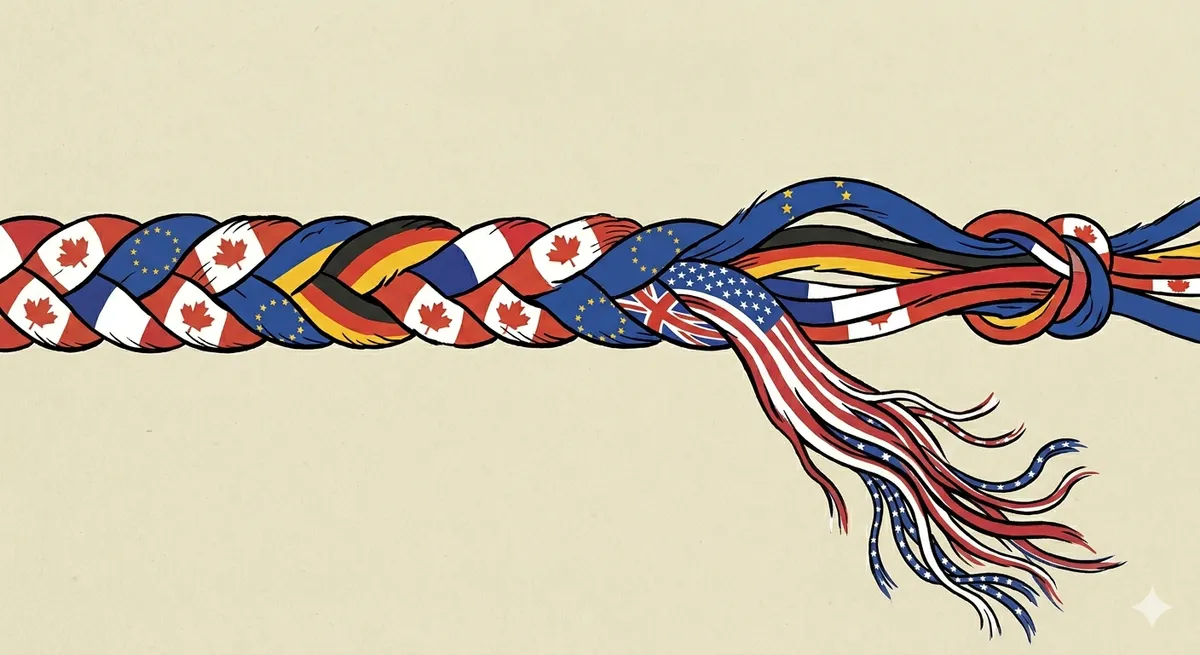
The comfortable way to read the current moment is that Trump is the problem and time is the solution. You hedge where you have to, you keep the intelligence channels open, you remember that American presidents come and go, and you wait for the grown-ups to turn up again. Europe mostly ran this playbook between 2017 and 2021, and it more or less worked. Biden showed up in January 2021 saying "America is back," a lot of foreign chancelleries took him at his word, and for four years they looked clever for having done so.
That playbook, somewhere between November 2024 and now, has been quietly folded up and put in a drawer.
The interesting question is why, because Trump in 2025 is not a meaningfully different man than Trump in 2017. Same instincts, broadly the same sentences, sometimes word for word. What changed is the rest of the world, specifically the story the rest of the world was willing to tell itself about who he represented. In 2016 there was a story available about an accident. An electoral college quirk, an electorate that had been conned by a reality TV star, a country that would correct itself once the bill came due. That story did enormous work, and every ally you can name was quietly leaning on it when they were figuring out how to handle the Muslim ban, the NATO threats, the Paris withdrawal, the rest of it. You don't have to like the guy, they told themselves, you just have to wait him out, because the Americans will.
Then 2024 happened, and the story went out of print. The first term had been lived through on camera. The record was documented, the tapes existed, the court filings were public, the cabinet picks were known quantities. And the electorate, with all of that in front of them, voted for a second helping. That was a choice made by the same people who had watched the first one play out and were now, with full information, asking for more of it. You do not price a choice the way you priced an accident.
The numbers, briefly
The polling is ugly in a way that would be hard to overstate. Pew surveyed 24 countries in the first months of the second term and found that in 19 of them, favorability of the United States had fallen from 2024, sometimes by 20 or 30 points. Confidence in the American president went from 63% under Biden to 18% in Germany, 63% to 15% in Sweden. The Democracy Perception Index, which tracks net global sentiment toward major powers, had the United States collapsing from something like +22 in 2024 to –5 by the spring of 2025, while China quietly climbed from about +5 to +14 in the same window. Across most of Western Europe, net perceptions of China now sit above net perceptions of the United States, a sentence that would have been unthinkable to write as recently as the Obama years.
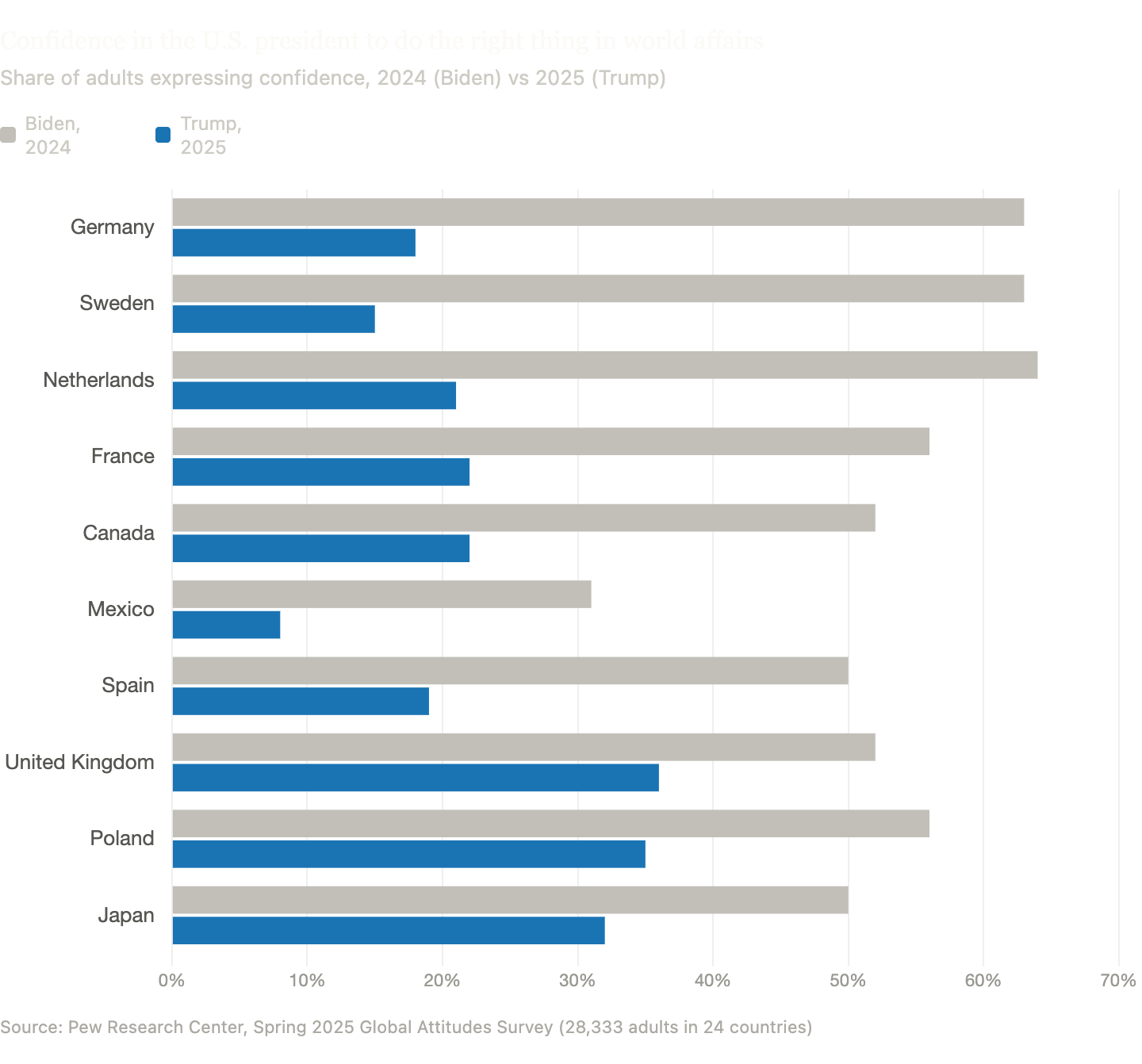
The numbers are only interesting insofar as they point to the thing you cannot poll for, which is the shift from "we don't trust your leader" to "we don't trust you." That is not the kind of update people announce. You have to read it off behavior, and the behavior is where the picture gets clearer.
Denmark, quietly
In March 2025, the chairman of Denmark's parliamentary defense committee, Rasmus Jarlov, said on the record that he regretted his country's decision to buy F-35s and that Denmark "must avoid American weapons if at all possible." Six months later, in September, Denmark went ahead and chose the French-Italian SAMP/T over the American Patriot for its long-range air defense. In December, Denmark's military intelligence service did something it had never done before in its history: it named the United States as a potential security concern, citing tariffs, economic coercion, and the rhetoric around Greenland.
The context here is not mysterious. The American President had spent most of a year saying he wanted to take Greenland, which happens to be Danish territory, and Denmark had concluded that he meant it. The official Danish line on the Patriot decision, to be fair, emphasized delivery timelines rather than politics. The Patriot wait was something like seven years, which is the kind of sensible procurement reason a sensible government always has ready to hand. Which is in fact the point. Allies with plausible technical cover stories can diversify away from American systems without ever having to say the words "because of Trump," and the fact that the cover stories are fluent and rehearsed tells you the diversification is a structural story rather than a tantrum.
Denmark has been in NATO since 1949. Nothing about Denmark's geography has changed. What changed is that Denmark is now drawing up its long-term defense plans on the assumption that the alliance's largest member is a variable it has to hedge against, and that is not a fact that will unwind when the Oval Office changes hands.
Germany, more quietly still
Germany is a subtler version of the same story, which makes it more interesting. Germany is not walking away from American systems. Germany is still buying F-35s for its nuclear-sharing role, still ordering Tomahawks for long-range strike, still expanding Patriot batteries for air defense. Germany cannot walk away from those purchases quickly, because nobody else in Europe makes equivalent kit at equivalent scale.
What Germany is doing is de-weighting. The Euronews coverage of the 2025–26 Bundeswehr procurement plan put the American share at around 8%, with the overwhelming majority going to European primes like Rheinmetall, KNDS, and Diehl. Berlin's new long-term shopping list, which runs to roughly $438 billion, has foreign-linked projects at less than 5% of total spend. A decade ago Germany's procurement was threaded through transatlantic supply chains in ways that would have made those percentages materially higher. None of that shift is dramatic in any single contract, but across the portfolio it is the whole story, which is exactly where these things are meant to be read.
The cleanest version of this story is Canada. In December 2025 Canada became the first non-European country to join SAFE, the EU's €150 billion joint-procurement fund. The following April, at the Liberal Party convention, Prime Minister Mark Carney put the strategy into a sentence: "The days of our military sending 70 cents of every dollar to the United States are over." Canada's new defense industrial policy is called "build, partner, buy," in that order, and the United States is the "buy" bit. A country whose capital is a ninety-minute flight from Washington has put the Americans at the bottom of its preference list.
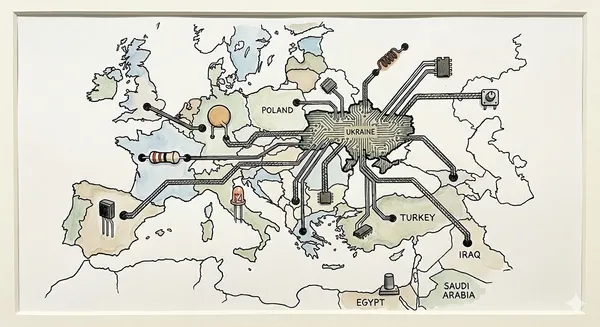
The defense procurement shift has a specific catalyst, because Ukraine's drone industry went from nothing to 4 million units a year while the US makes 50,000, and that production gap gave every European government the confidence to say no.
The days of our military sending 70 cents of every dollar to the United States are over.
None of this is theatre, and nobody in the defense ministries involved is under any illusion that it is. Multi-decade defense procurement is the most expensive and least reversible signal a state can send about how it expects to live in the world for the next thirty years. A Patriot bought in 2025 is a relationship that runs to 2055. A Patriot not bought, or a SAMP/T bought instead, is a different relationship in 2055, whether the American president in 2029 is a Democrat, a Republican, or someone nobody has heard of yet.
The comfortable counterargument
At this point the reasonable reader pushes back, because I would want to push back here too. Democracies recover all the time. Germany after 1945, France after Vichy, the United States itself after Nixon and Iraq and plenty of things worse than gerrymandering. Electorates make mistakes and then correct them, 2016 was the mistake and 2020 was the correction.
It is a good argument and I have been turning it over for about 6 months. It has one real problem, which is that it treats recovery as a weather pattern when recovery is actually a piece of machinery. Democracies bounce back because they build the machinery to make the next time structurally harder, and foreign partners eventually look at the machinery and decide they can trust it.
Germany is the worked example, and it is the one people wave at without examining. The reason West Germany was allowed back into the respectable half of the world after 1945 was that the Germans built something. The Basic Law of 1949 was written on purpose as a counter-model to Weimar. The Federal Constitutional Court was given the authority to ban political parties that threatened what the constitution calls the "free democratic basic order," and the court actually used that authority, banning the neo-Nazi Socialist Reich Party in 1952 and the Communist Party of Germany in 1956. A domestic intelligence service was set up specifically to monitor anti-constitutional activity. Civil servants had to swear loyalty to the constitution. The Germans called the whole arrangement wehrhafte Demokratie, fortified democracy, and the point of it was to put a spine into the system so a determined minority could not legally dismantle the state from within, the way the Nazis had in 1933. On top of that, Germany tied itself into NATO and the European project with knots that made defection expensive to the point of impossibility.
That is the machinery. Forty years later, when the Wall came down and people were nervously asking whether a unified Germany should be allowed to exist, you could point at it and say, look, we built the thing. The trust was in the thing. The thing is still there eighty years on, give or take the live argument about whether to ban the AfD.
America is dismantling its tripwires
The thing that makes the current American moment different from ordinary political misbehavior is that none of it was hidden. It was written down, printed, bound, and sold in advance.
In April 2023, a year and a half before the election, the Heritage Foundation published a 900-page book called Mandate for Leadership. You may know it better as Project 2025. Heritage says more than 350 conservatives contributed, more than a hundred organizations stood behind it, and CNN would later identify at least 140 former officials from the first Trump administration among the authors and contributors. Between the covers it described in plain prose exactly what a second Trump administration would do. Make career civil servants fireable at will. Refuse to spend money Congress had appropriated. Clear out the senior ranks of the State Department. Take partisan control of the Justice Department, the FBI, the FCC. Abolish the Department of Education. The works. Trump spent the campaign saying he had nothing to do with it, had never read it, did not know who was behind it. Then he won, and the authors showed up for work. The man who wrote the impoundment chapter is now running the Office of Management and Budget. The man who wrote the FCC chapter is now chairing the FCC. CNN went through the executive orders Trump signed in his first week back in office and found that roughly two-thirds of them mirrored Project 2025 recommendations line by line.
The American electorate had access to all of this. Democrats held the book up on stage at the DNC in August 2024 on live television. The summary was in every major newspaper. The authors gave interviews. And the electorate, looking at the syllabus, voted to enroll in the course. This is the hinge of the whole argument, because it is what makes the trust break structural. A country can recover from a bad leader. A country has a much harder time recovering from having told the world, in advance, in print, exactly what it was going to do, and then doing it while the world watched.
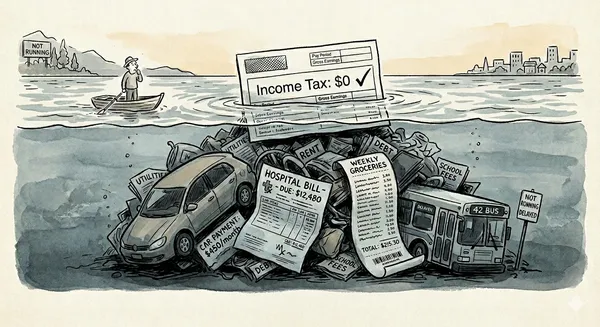
The erosion is not just geopolitical. Domestically, the social contract between corporations, government, and workers has been hollowing out for decades, and the institutional weakness that makes recovery harder abroad is the same weakness that enabled the transfer of wealth at home.
And now, a year into the term, the book is being executed against the institutions that would normally absorb it. The Republican congressional majority has, broadly, stopped using its oversight powers. The administration has been impounding congressionally appropriated funds, which is a direct assault on the power of the purse that Congress spent the decade after Nixon reinforcing, and Congress has, broadly, chosen to sit on its hands and watch.
Then there is the redistricting, which has the unusual virtue of a clean timeline. In July 2025, Trump publicly told Texas Republicans to redraw the state's congressional map to protect the House majority in 2026. A few days later the Department of Justice sent Governor Greg Abbott a helpful letter declaring the relevant districts unconstitutional, which provided the cover story. Texas signed a new map at the end of August. Missouri followed in September. North Carolina in October. Before 2025, two states had voluntarily redistricted mid-decade since 1970. In a six-month window after Trump asked, several did it in coordination. If you tried to sell this sequence as a plot point in a political novel your editor would tell you to pull it back because nobody would believe the timing.
Then the courts stepped in, and then they stepped back out again. On November 18, a three-judge federal panel in El Paso, in an opinion written by a Trump appointee, found that the Texas map was a racial gerrymander and barred its use. On December 4, the Supreme Court stayed that ruling 6–3 and let the map be used in the 2026 midterms anyway. Justice Kagan's dissent pointed out that the election was eleven months away and the primary could be moved, so the emergency intervention was hard to justify even on procedural grounds. The majority did it anyway. The upshot is that a map a trial court had found was drawn along racial lines, in a country whose Voting Rights Act prohibits drawing maps along racial lines, will be used to elect the 2026 Congress.
None of this, taken piece by piece, is unprecedented. Both parties have gerrymandered for decades, Supreme Court emergency rulings have been getting sharper elbows for years, congressional oversight has been partisan since Newt Gingrich got bored. What is new is everything happening at once, pointing the same direction, coordinated at the top, and running from the pages of a book that was on sale at airport bookstores in 2023. The American system is rearranging its load-bearing walls to fit the shock rather than absorbing it, on purpose, while everybody watches.
The asymmetry
Trust between countries is the slowest-moving asset on earth. West Germany spent forty years rebuilding it, through the Basic Law and Brandt kneeling at Warsaw and Vergangenheitsbewältigung worked into the schools and the museums and the political culture for a generation. By the 1990s the world was willing to let Germany reunify, which was a genuinely open question as late as the Reagan years. Forty years of slow, patient, unglamorous work.
Losing trust does not take forty years. It takes a handful of election cycles and a decision to pull out the tripwires, which is what is happening now. The American clock started ticking the wrong way in November 2024, and every month of the current term that passes without a serious institutional defense makes the road back longer.
The honest question, the one I keep coming back to, is not whether America's allies are overreacting, because they are not. The honest question is what they would have to see between now and the 2028 election to start reacting the other way. A Republican Party that separates itself from its leader on principle. A court system that resists rather than ratifies. A Congress that remembers it controls the purse. An electorate that treats the midterms as a repudiation rather than a mandate. Those are the tripwires. Rebuilding the machinery would look something like restoring them.
The domestic side of this equation, whether Democrats can produce a vision that rebuilds institutional credibility rather than just running against Trump, is an open question with no encouraging answer.
None of them, at the moment, are happening.
Sources
Pew Research Center, "U.S. Image Declines in Many Nations Amid Low Confidence in Trump," June 11, 2025, on the 24-country survey and the Biden-to-Trump confidence shifts in Germany and Sweden.
Democracy Perception Index 2025, Nira Data and the Alliance of Democracies, on net global perception scores for the United States and China. (The Ipsos Global Advisor survey of the same period measured a related but distinct metric, with US positive-influence perception falling from roughly 60% to 46% across 24 countries.)
Rasmus Jarlov, post on X, March 19, 2025, and reporting by AOL/Business Insider ("Denmark's defense committee head said he regrets choosing the F-35," March 24, 2025) for the Jarlov regret statement. Defense News, Breaking Defense, and Army Recognition, September 12–15, 2025, for Denmark's SAMP/T selection. CNN and Bloomberg, December 10, 2025, on the Danish Defense Intelligence Service "Outlook 2025" report naming the United States as a potential security concern. Carnegie Endowment, "Rebalancing the Transatlantic Defense-Industrial Relationship," December 22, 2025, for synthesis. Norsk Luftvern, January 2026, and NATO Admiral Pierre Vandier's August 2025 statements, on the ~7-year Patriot delivery timeline.
Defence Industry Europe, "Germany plans nearly €83 billion in defence contracts by 2026, most to European industry," September 24, 2025, for the ~8% US share of German procurement (based on Politico's September 2025 reporting on internal Bundeswehr documents). Euronews, December 2025, and The Defense Post, "Germany Sets Out $438B Defense Shopping List," October 2025, on the composition of German procurement and the foreign-linked share of the long-term shopping list.
Al Jazeera, "Canada joins key EU defence programme as PM Carney pivots away from US," December 2, 2025, and subsequent reporting on Carney's Liberal Party convention remarks, April 2026, on the 70-cents-of-every-dollar framing.
Ballotpedia, "Redistricting in Texas ahead of the 2026 elections"; Texas Tribune, "Federal court blocks new Texas congressional map for 2026," November 18, 2025; NPR and SCOTUSblog, December 4–8, 2025, on the Supreme Court stay.
Bundesamt für Verfassungsschutz, "Protecting the constitution," and Wikipedia, "Basic Law for the Federal Republic of Germany" and "Defensive democracy," on wehrhafte Demokratie, Article 21 GG, and the 1952/1956 party bans.
Chicago Policy Review, "Executive Power Play: Trump and the Return of Impoundment," April 2025, on the impoundment revival.
The Conversation, "How Project 2025 became the blueprint for Donald Trump's second term," March 2026; Wikipedia, "Project 2025"; ACLU, "Project 2025, Explained"; and CBS News coverage of the Heritage Foundation's Mandate for Leadership, November 2024.