The Survivor's Paradox: How Layoffs Turn Companies Into Yes-Machines
After layoffs, every remaining employee runs the same calculation: agree with the exec, ship what they want, never push back. Meta's own staff flagged nobody used Horizon Worlds before the first cuts landed, and the company burned another $75 billion on metaverse losses before calling it.

Every tech company right now seems to be in a constant state of "restructuring," which is the polite corporate word for removing a few thousand people from the payroll while the CEO talks about how the company has never been stronger. The layoffs themselves have been written about extensively and they should be, because losing your job in America means losing your healthcare, your stability, and in a lot of cases your visa status. That part of the story gets the attention it deserves.
What gets far less attention is what happens to the people who didn't get laid off. This article is not really focusing on their mental health, but rather the psyche of the company and the shifts that come with a layoff.
The people who remain after a layoff on the surface look absolutely fine. They still have their jobs, they still have their Slack logins, they still have meetings on their calendar with titles like "Q2 Roadmap Alignment." But something has happened to the culture around them that doesn't show up on any spreadsheet, and if you have ever sat in a post-layoff all-hands and watched the questions in the chat go from pointed to performative over the course of a single hour, you already know where this is going.
Layoffs don't just reduce the headcount, they reshape the way everyone who is left behaves. And the way people behave afterwards is almost always worse for the company than the way they behaved before.
The three options every survivor runs through
When a round of layoffs lands, every person still employed runs the same quiet calculation, usually without realizing they are running it. The question they are asking themselves, underneath all the public talk about resilience and moving forward, is a very simple one. When the next round comes, and everyone assumes there will be a next round, how do I avoid being on the list?
There are three ways you can be perceived when that moment arrives.
- You can be remembered for the impact you've brought. The good kind. Shipped things, visible wins, execs who know your name for a good reason. This is the safest place to be, and on the surface it sounds lovely because companies are always telling you to drive impact anyway. Keep that in mind for a second, we'll come back to it.
- You can be forgettable. Nobody has a strong opinion on you one way or the other. You do your job, you don't make waves, you don't come up in conversation. This is the middle ground and it is genuinely the least stable position, because when an exec is staring down a list of names trying to decide who stays, "I have no idea who that is" almost never plays in your favor. Forgettable is a coin flip at best.
- You can be remembered for the wrong reasons. That time you pushed back hard on a VP's pet project. The heated thread in Slack where you told a director their plan wouldn't work. The all-hands question that made the CFO visibly uncomfortable. Everything on that list might have been the right thing to do at the time, but now it lives rent-free in somebody's head, and that somebody might be in the room when the next cut list gets drawn up. Category three is a paper trail, and paper trails have a habit of being read at exactly the moment you'd rather they weren't.
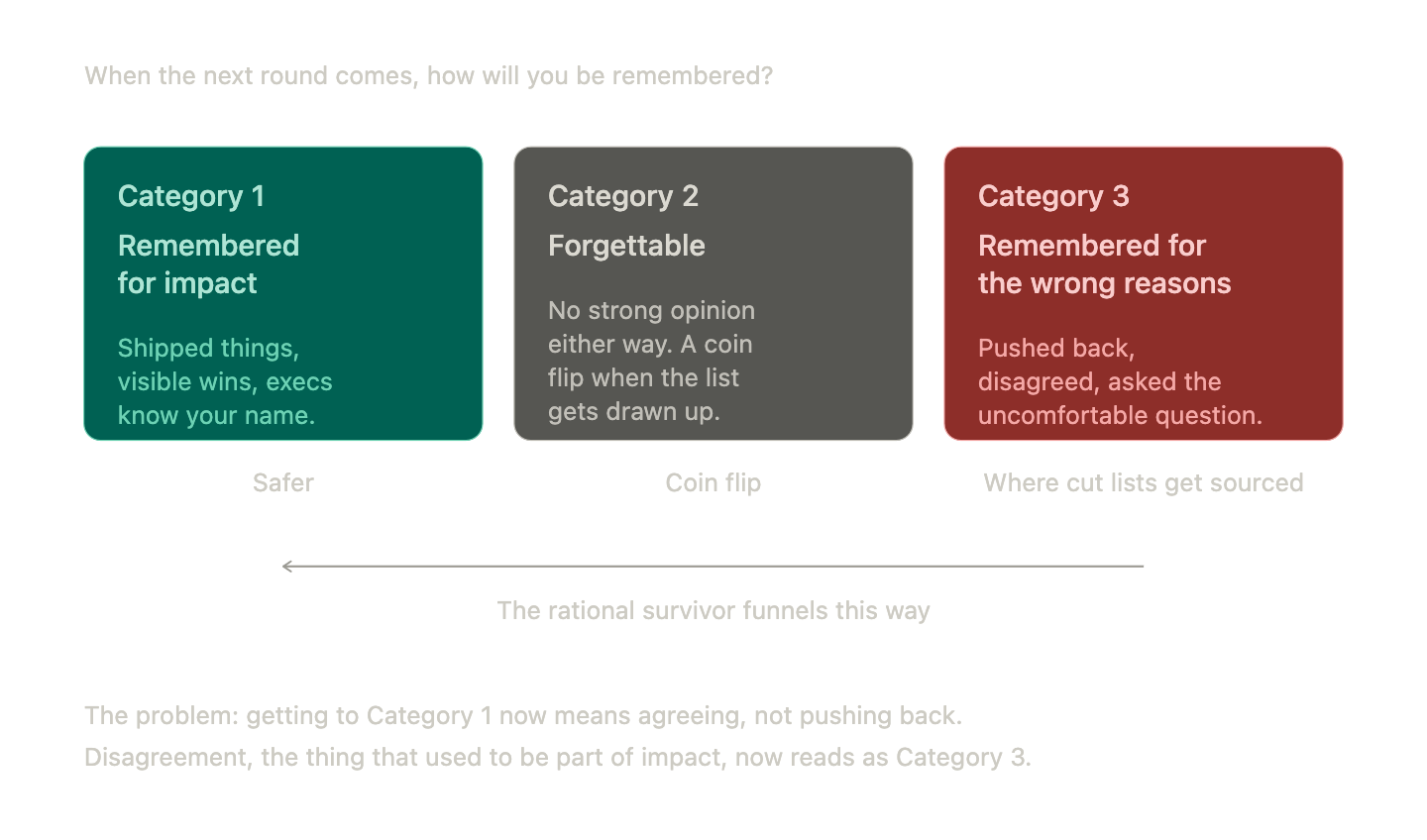
So if you are a rational person trying to keep your job, and almost everyone is a rational person trying to keep their job, the only sensible play is option one. Be remembered for impact. Do big things. Ship big things. Be the person who makes the exec's vision happen.
And this is exactly where the whole thing quietly falls apart.
What impact is supposed to mean
In a healthy company, impact means doing good work, and doing good work includes pushing back when the idea is bad. It means saying "we tried this two years ago and here's what happened." It means telling the VP that the timeline they just committed to in front of the CEO is not physically possible. Pushback is part of impact. Friction is part of the product. The reason the best companies ship good things is that somebody in the room was willing to be the person who said "hang on a minute." Every exec asked about their management philosophy will tell you exactly this, that they want to be challenged, that the worst thing for a company is a room full of people nodding. You will not find an exec anywhere who will publicly say they prefer their subordinates compliant and quiet.
Post-layoff, the math on pushback changes, and it changes in a direction that is obvious the moment you write it down. If you push back and you are right, you get some quiet credit from the people who noticed, and quiet credit is a currency that doesn't really spend anywhere. If you push back and the exec takes it personally, you have just moved yourself from category one to category three, and category three is where cut lists get sourced. The upside is a pat on the back in a one-on-one. The downside is your name on a slide in a meeting you will never be invited to.
Under those conditions, pushback stops being part of impact and starts being a career risk that only the genuinely reckless or genuinely senior are willing to take. And "impact" becomes something else. It becomes the performance of impact. The visible shipping of things the exec wanted shipped. Enthusiastic agreement with the strategy, regardless of whether the strategy is any good. Being the person who takes the brief and runs with it, even when the brief is the corporate equivalent of telling somebody to sprint into a wall. You are not delivering impact at that point, you are delivering compliance theatre with impact as the marketing copy.
The irony is that the tool supposedly driving these cuts cannot produce the original thinking that companies claim to value, because it optimizes known patterns, which is exactly what a yes-machine culture produces too.
The tragedy is that it works. In the short term. You keep your job, you get remembered positively, and the exec walks away thinking their plan was validated by the enthusiasm of the team. That enthusiasm was a survival response, but it looks exactly like belief, and execs are not generally known for their willingness to investigate the difference.
The feedback loop nobody wants to name
Once a company has a few rounds of layoffs behind it, the survival response starts to compound in a way that nobody really plans for.
It goes something like this. Layoffs happen. Survivors adjust their behavior to avoid category three, which means pushback quietly dries up. Execs, now operating in a room where everyone seems to agree with them, interpret that agreement as validation. Decisions get made without the friction that would have caught the bad ones. Some of those decisions go wrong, as decisions do. When the results come in, the explanation is never "we made a bad call because nobody could afford to tell us it was a bad call," because that explanation requires an exec to admit their own culture was the problem. The explanation is always "we need to get leaner and more focused," which is corporate for another round of layoffs, which tightens the loop another notch, and on it goes.
I want to be honest about something, because I think it matters. Layoffs on their own do not invent this dynamic out of thin air. If a company's governance is healthy, if the execs genuinely want to be challenged rather than just claiming to in interviews, if dissent is actually rewarded in visible ways rather than just tolerated when it's convenient, layoffs hurt morale but the correction mechanism survives. The problem is that layoffs amplify and formalize a dynamic that bad governance was already encouraging. And there's a harder version of the same observation, which is this. Even if a company didn't have a yes-machine culture before the layoffs, it will have one after. Because who, looking at the empty desks of people they had lunch with last Tuesday, is going to be the one who disagrees with an exec in the next product review? Nobody with a mortgage. Nobody on a visa. Nobody with childcare costs. And those are most of the people.
The dynamic hits some groups harder than others. Women, who already took a disproportionate share of the first wave of cuts, are now being scored on AI-usage metrics that the research shows they were least encouraged to adopt.
You can see the shape of this in Blind threads where the anonymity gives people permission to say what they actually think, in leaving drinks where people who have already signed somewhere else describe the specific meeting where they tried to raise a concern and got the look that told them never to do that again. But you can also see it in the numbers of one very specific company, and the timing of that company's layoffs is where this argument earns its keep.
Meta, a very expensive case study
In September and October of 2022, internal memos leaked from Vishal Shah, then Meta's VP of Metaverse. Shah was writing to employees about Horizon Worlds, Meta's flagship metaverse product, and the problem he was trying to address was a specific one. Meta's own employees were not using the product. His own words, in writing, in a memo addressed to his organisation: "for many of us, we don't spend that much time in Horizon and our dogfooding dashboards show this pretty clearly." His solution was to mandate that managers force their teams to use Horizon Worlds at least once a week, so that they might, to use his phrasing, "fall in love with" the thing they were building.
"For many of us, we don't spend that much time in Horizon and our dogfooding dashboards show this pretty clearly."
If the people building a product don't want to use it in their own free time, that is a signal. A loud one. It is roughly the loudest signal you can get inside a company short of a petition. What it tells you is that the thesis of the product is not landing even with the people who have the most reason to want it to land, the people whose jobs and bonuses and stock vesting depend on it being good.
That was September and October 2022.
In November 2022, Meta announced its first mass layoff in company history. Eleven thousand people, thirteen percent of staff. Zuckerberg said in his letter that he took accountability for the decision. He did not say, at any point, that the strategy driving Reality Labs spending was being reconsidered. The order matters. The internal dissent came first. The layoff came after. Meta's employees had been telling the company, in leaked memos and through their own behavior, that the product wasn't working, and what they got in return was the biggest layoff in the company's history and a continued public commitment to the metaverse strategy.
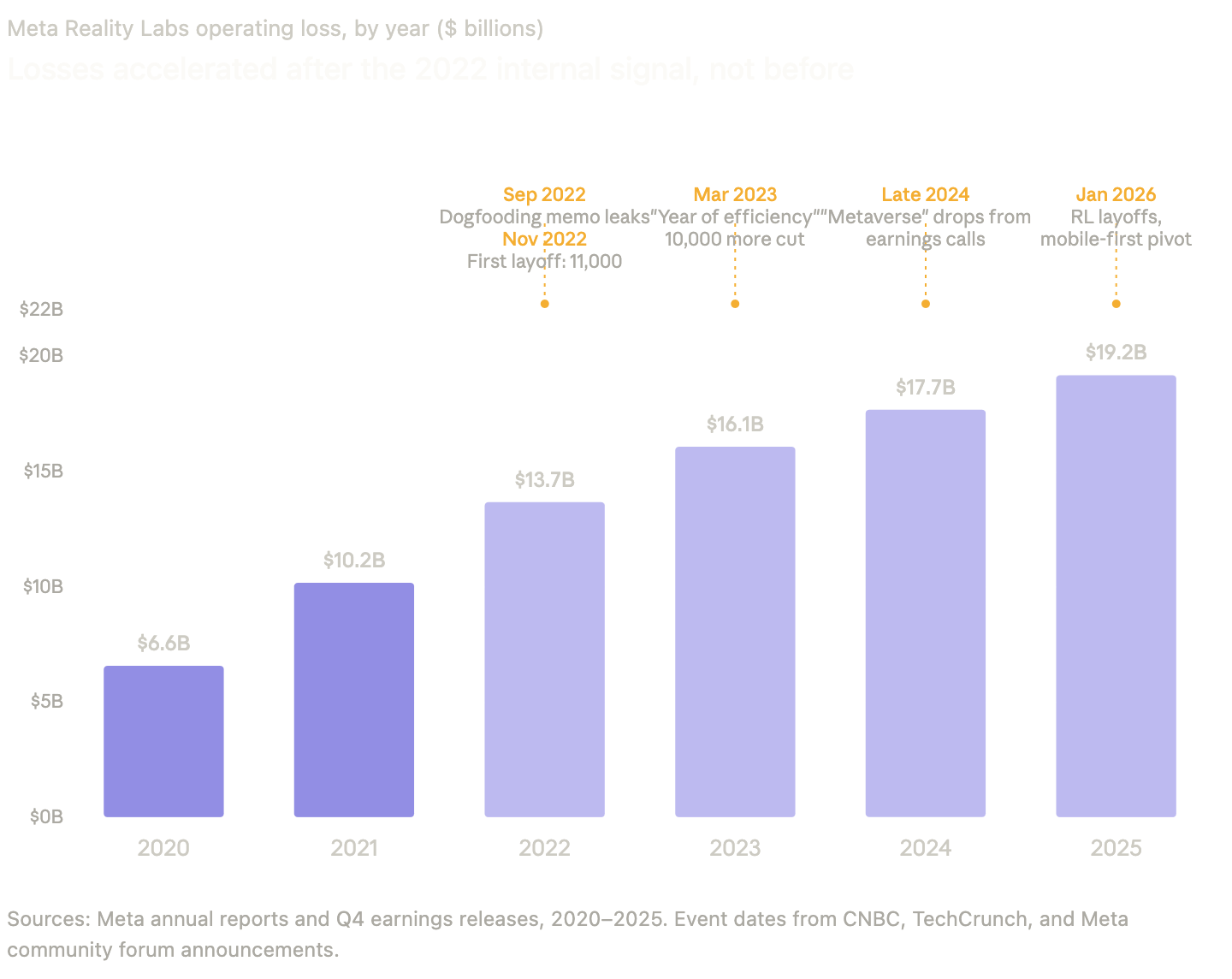
Reality Labs lost $13.7 billion in 2022. In March 2023, Meta did another round of layoffs, ten thousand more people, packaged as the "year of efficiency." Reality Labs losses for 2023 came in at $16.1 billion. In 2024, the division lost $17.7 billion. In 2025 it lost $19.2 billion. Cumulative losses on the metaverse bet now sit somewhere around $83 to $90 billion depending on who is counting, and it was not until early 2026 that Meta quietly shut down Horizon Worlds on VR, skipped any mention of the metaverse on their earnings call, and pivoted to AI and smartglasses. The internal signal in 2022 was treated as a performance management problem. The external signal from the AI boom in 2026 was treated as a strategic one. The difference between those responses is the difference between a culture that can correct itself and a culture that cannot, and the price of that difference is somewhere in the region of $75 billion of continued losses between the moment somebody could have called it and the moment somebody finally did.
"But Meta's stock is up"
This is the obvious rebuttal and it deserves a proper answer, because if you don't address it the argument falls over.
Meta's stock is up. Meta is making obscene amounts of money. The ads business is one of the most profitable machines in the history of commerce. None of this is in dispute. The argument has never been that Meta is dying. The argument is that Meta set roughly $90 billion on fire chasing a strategy that was visibly failing by 2022, and the reason the company could keep doing it for another four years is precisely because the ads business is such a cash machine that it could absorb the losses long enough for a bad decision to become a historically bad decision. The ads business did not prevent the wrong call. The ads business funded the wrong call for a decade. Companies with a cash cow can sustain wrong-headed strategies far longer than companies without one, and a culture that cannot correct itself is the thing that turns a bad bet into a record-setting bad bet.
There is a related rebuttal, which is that Zuckerberg controls 61% of Meta's voting shares, so he could ignore internal dissent whether or not the layoffs happened. That is fair and I am not going to pretend it isn't. Meta's governance structure is bad on its own terms, and it would be bad without a single layoff ever having taken place. What the layoffs did was remove the last remaining informal cost of making a bad decision. If the only people left in the room are the ones who have learned through watching their colleagues get walked out that enthusiasm keeps them employed, you have built an exec class that is insulated from information, and insulated execs make expensive mistakes with metronome regularity.
The yes-machine culture is not a Meta problem alone. It is the predictable outcome of an industry-wide pattern where the AI narrative gave every company simultaneous permission to cut, and the survivors learned to perform rather than push back.
What this means if you're still inside one
The paradox at the heart of surviving a layoff is that you are told, explicitly and implicitly, to bring your best self to work. Drive impact. Challenge assumptions. Be bold. And then the incentive structure, the one that was created the moment the first Zoom call went out with the subject line "we need to talk," makes all of that a career-ending move. You are asked to behave as if the old culture is still intact, while the new culture punishes anyone naive enough to believe it.
A company culture after layoffs is not the same company culture it had the day before the announcement. It looks like the same company. Same logo, same offices, probably mostly the same people. But something has been broken that doesn't show up in the quarterly numbers for years, and by the time it does, everyone who could have prevented it has either been laid off, been promoted, or learned to keep their head down.
Which, if you think about the incentive structure for long enough, is exactly what that structure was designed to produce.