AI and the Productivity Fallacy
Klarna replaced 700 agents with a chatbot, became the poster child for AI productivity, then quietly hired humans back after quality collapsed and the CEO admitted they'd "gone too far." The pattern is repeating across the industry while the actual productivity data remains vanishingly thin.


There is a lot of hype around AI right now. A lot. You cannot open LinkedIn, sit through an earnings call, or read a business publication without being bludgeoned by the same message, which is that AI is a 10x productivity unlock, a paradigm shift, a once-in-a-generation moment that will let everyone do less and produce more. The influencers are selling courses about it, the CEOs are restructuring around it, and the headlines are breathless enough that you would think we had collectively stumbled into some kind of economic utopia.
Taken at face value, the story is clean. Companies lay off workers, cite AI-driven productivity gains, and report record profits to their boards and shareholders. Costs come down, margins go up, everyone nods approvingly on the investor call. Sounds brilliant, sounds like the future, sounds like something that should hold up to about thirty seconds of scrutiny before the whole thing starts to smell off.
The Klarna Round Trip
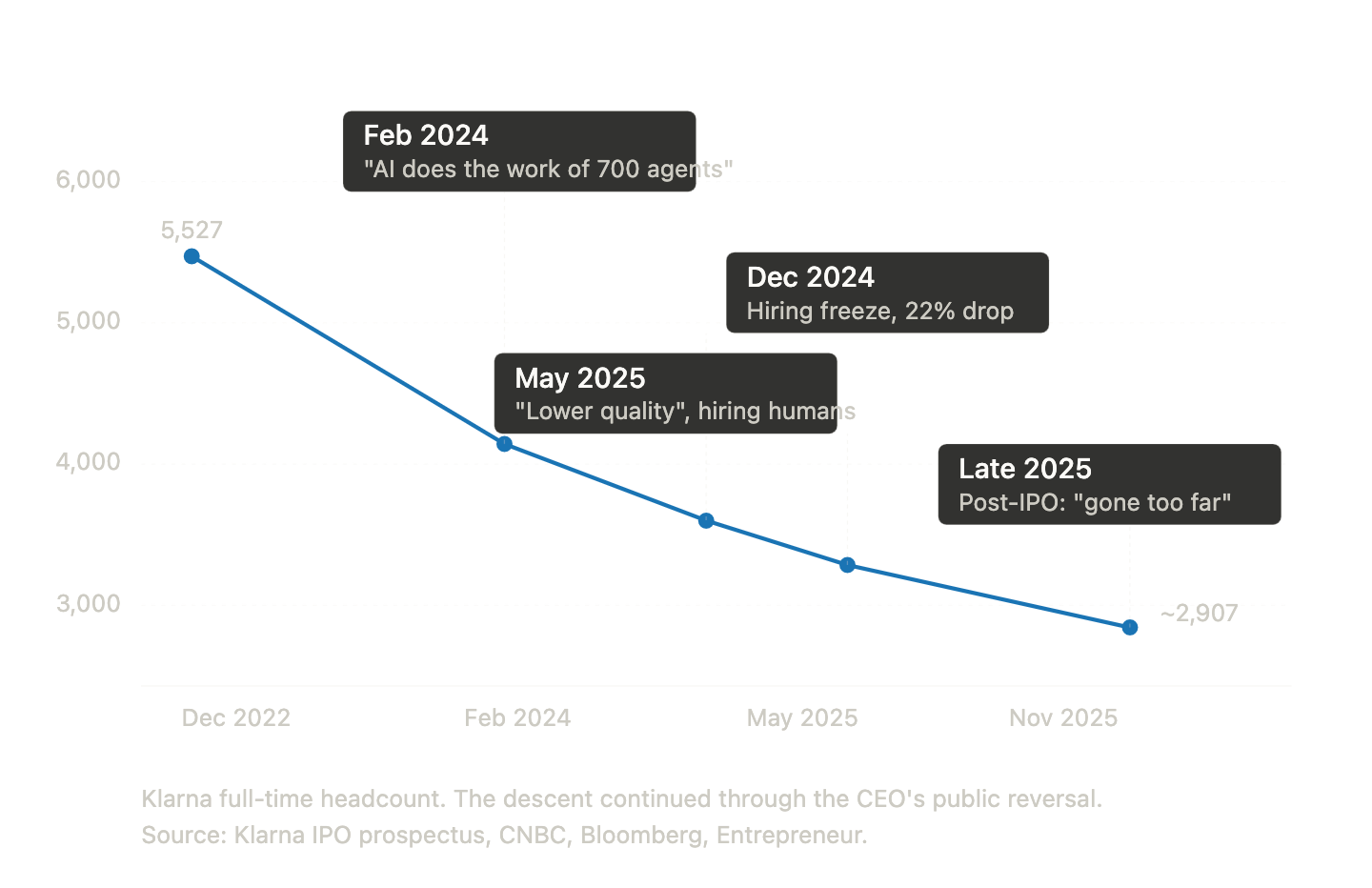
In February 2024, Klarna announced that its OpenAI-powered chatbot was doing the work of 700 customer service agents and had handled roughly two-thirds of customer chats within weeks of launch. CEO Sebastian Siemiatkowski spent the next eighteen months telling anyone who would listen that AI could cut Klarna's headcount in half. The company froze hiring, watched its headcount drop 22% through attrition to around 3,500 employees, and became the flagship case study for the AI productivity revolution. The story was repeated on conference stages, in earnings calls, and across every think piece about the transformation of work.
Then it quietly came apart. Customer satisfaction dropped, complex issues broke the chatbot, complaints piled up, and by May 2025 Siemiatkowski was telling Bloomberg that the AI-first strategy had produced "lower quality" output and that Klarna was hiring human agents again. In the months after Klarna's US IPO later that year, he went further, admitting the company had "gone too far" and acknowledging that focusing on efficiency and cost had eroded customer trust. The projected savings never fully materialized, because the quality problems consumed more than the headcount cuts saved. The flagship case study became a flagship cautionary tale, and the man who had been quoted everywhere about AI replacing half his workforce was now on Bloomberg saying that investing in the quality of human support was the way of the future.
Klarna is not a fringe case. It is the cleanest, most publicly documented version of a pattern now playing out across the economy, where the productivity claims are louder than the productivity, and where the actions quietly contradict the press releases.
If They Believed It, They Would Bet On It
If AI were genuinely delivering the productivity multiples the headlines suggest, the rational corporate response would not be to shrink. If your 500 employees suddenly have the output capacity of 1,500 or 5,000, you are sitting on a machine that converts headcount into disproportionate value, and every additional hire is worth multiples of what they were worth before because the tool amplifies what they can do. The marginal employee has just become significantly more attractive as an investment, not less.
So why not hire. Why not take even a fraction of those record profits and pour them into a workforce that, according to your own public statements, now produces dramatically more value per person. Think about what that would mean for market share, for go-to-market speed, for competitive positioning against the laggards. A company that genuinely believed it had a 3x productivity multiplier and chose not to expand would be making one of the most indefensibly conservative strategic decisions imaginable, which is the corporate equivalent of finding a printing press and deciding to make fewer books.
What is happening is the opposite. Amazon cut roughly 14,000 corporate jobs in October 2025 and another 16,000 at the start of 2026, with SVP Beth Galetti explicitly pointing to AI as the reason the company could operate more efficiently with fewer people. Accenture announced about 11,000 cuts in December 2025 tied to how AI is reshaping work inside the firm. Meta made the most theatrical version of the trade in March 2026, announcing a $27 billion AI infrastructure deal with Nebius alongside leaked reports of cuts affecting up to 20% of its workforce, a swap the market rewarded with a 3% stock pop on the day. ASML, riding the AI boom with record orders, announced 1,700 job cuts on efficiency grounds, with another 1,300 to follow. The boldness only ever shows up in the earnings call narrative. It never shows up in the capital allocation.
Profit Is Not Productivity
One of the most common sleights of hand in this whole conversation is the conflation of cost reduction with genuine productivity improvement. When a company fires 200 people, keeps revenue flat, and reports higher margins, the spreadsheet looks great, but nothing in that scenario requires AI to have actually made anyone more productive. You could get the same result by any number of cost-cutting moves that have nothing to do with technology, and companies have been doing exactly that for decades whenever they want to juice a quarter.
You cannot simultaneously claim that AI has transformed what your business is capable of doing and then deploy the resulting surplus in the most imagination-free way available.
The financial pattern around the current round of cuts makes this hard to ignore. Tech layoffs crossed 157,000 in 2025 alone, according to Layoffs.fyi, and while CEOs cite AI efficiency, the accompanying decisions tell a different story. Stock buybacks, dividend increases, and executive compensation packages are all up across the major companies doing the cutting. If these firms were responding to a genuine transformational productivity unlock, you would expect that capital to flow toward growth, and if they were genuinely struggling you would expect buybacks to get cut first, because buybacks are the easiest line to pause when cash gets tight. Instead, workers are absorbing the cost while the capital returns to the top of the stack. The efficiency is real. The productivity story is the wrapper around it.
Those cuts did not land evenly across the workforce, and the group absorbing the worst of them is now walking into a second filter, because the AI-usage scores that will sort the next round have their own demographic skew.
Record profits do not prove that remaining employees are producing more, or better, or faster. They prove the company is spending less money, which is a completely different claim. The stock market rewards margin expansion regardless of where it comes from, and executives have learned that dressing cost cuts in the language of AI transformation makes them sound visionary rather than cheap. That is not an accident, that is the whole point of the rhetoric.
The people who survived the cuts have learned in the meantime that compliance keeps them employed, which means the internal feedback loops that might have caught the next Klarna are being quietly dismantled.
The mechanism behind this pattern, how AI gave companies permission to compress wages industry-wide while calling it transformation, is the subject of a separate essay.
What The Research Actually Says
Step away from the press releases and the controlled studies paint a much more modest picture than the 10x narrative suggests. The most optimistic one, the 2023 Harvard Business School and BCG experiment with 758 consultants, found that on tasks inside the AI's capability frontier, consultants using GPT-4 completed 12.2% more work, 25.1% faster, with 40% higher quality output. Junior consultants gained 43%, seniors gained 17%. These are real, meaningful numbers that any executive should be pleased to see in a tool rollout.
They are also a long way from 10x, and on a managerial task the researchers deliberately selected because it sat just outside the AI's frontier, consultants using GPT-4 were 19 percentage points less likely to produce correct answers than those without it. The tool quietly degraded their work and they could not tell.
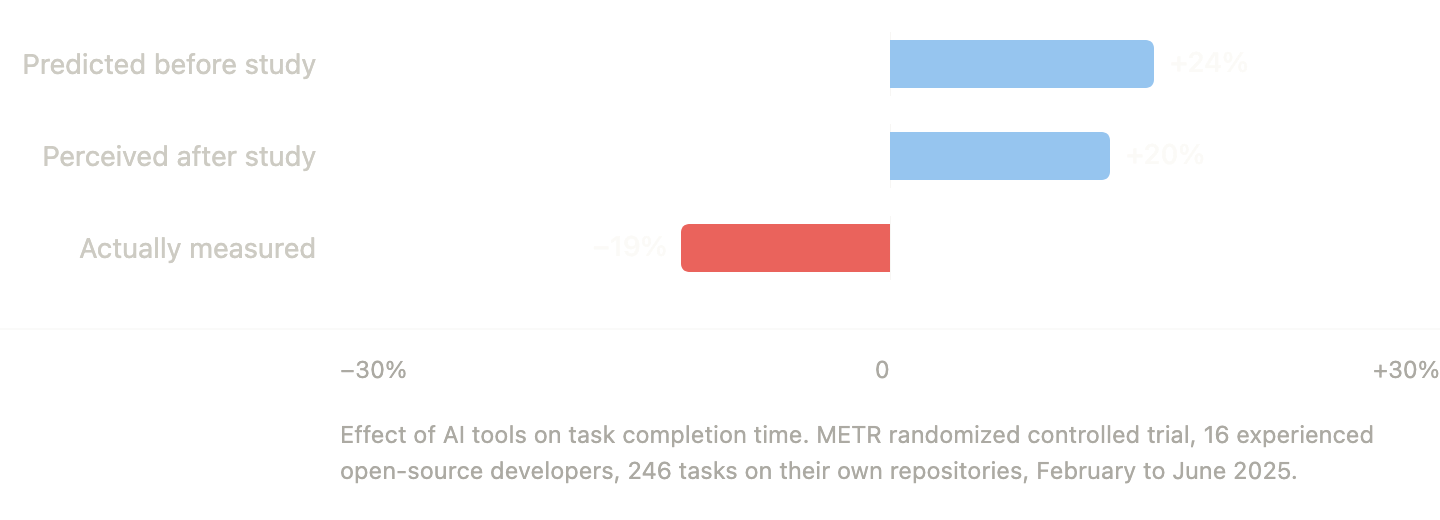
The pessimistic counterpoint comes from METR, a nonprofit that ran a randomized controlled trial with 16 experienced open-source developers in mid-2025. The developers predicted AI tools would speed them up by 24%, then after the study reported feeling 20% faster, when in fact they were 19% slower. The gap between perception and reality was the striking finding, and it replicated. METR has since acknowledged selection effects in the original study design and updated their estimate for 2026 to something closer to a 4% slowdown, well within the noise, but the robust finding is the perception gap itself. People consistently believe AI is helping them considerably more than the measurements show.
Then there is MIT's State of AI in Business 2025 report, the one whose headline number has circulated everywhere: 95% of enterprise generative AI pilots deliver no measurable impact on profit and loss. The methodology has been fairly criticized, because the success criteria are narrow, six months is a short window, and plenty of AI value does not show up on a P&L in that timeframe. Even the sympathetic reading is rough, though. Only 5% of integrated pilots produce real financial returns, only 26% of companies have made it past proof of concept, and of the $30 to $40 billion in enterprise AI spending the report tracked, most of it is producing very little visible ROI. The study also notes that the workforce disruption happening so far is mostly companies quietly not backfilling roles, rather than the sweeping AI-replaces-humans transformation being announced on stage.
The honest synthesis across all of this is that AI offers meaningful but uneven gains, roughly 10 to 25% on well-scoped tasks within its competence, larger for novices being lifted to competence, smaller for experts working inside their own expertise, sometimes negative when people misuse it or push it past its limits. That is a genuinely useful technology. It is not a paradigm shift, and it is nowhere near sufficient justification for the workforce reductions being carried out in its name.
The Argument Worth Taking Seriously
There is one steelman version of the layoff-without-expansion story that deserves a real response, which is that demand is fixed in the short term, and firms with more productive workers simply need fewer of them. A law firm with AI-augmented associates does not need twice as many lawyers because its client roster is what it is. An insurance company does not suddenly sell more policies because its claims adjusters are faster. On this reading, the layoffs are not evidence of disbelief in AI, they are evidence that productivity gains in a fixed-demand market show up as cost reduction rather than expansion, which is exactly what economic theory would predict.
This is a fair argument and it is partially correct. It also proves less than it appears to. Genuine productivity unlocks historically redeploy capital rather than just banking it, whether that is into adjacent markets, new product lines, faster geographic expansion, or aggressive pricing to capture share from competitors who have not caught up yet. A 15th-century printer who suddenly got twice as productive did not hire twice as many printers, but the savings went into new titles, cheaper pamphlets, books for audiences that previously could not afford them. The press created whole markets that had not existed.
The current corporate pattern is doing none of that. The savings are going into buybacks and dividends, which is the most conservative possible destination for a supposed revolution. That is not a company reinvesting productivity gains into growth, that is a company treating AI as a one-off margin expansion event and cashing out. You cannot simultaneously claim that AI has transformed what your business is capable of doing and then deploy the resulting surplus in the most imagination-free way available.
Follow The Actions
The simplest and most reliable test of whether someone believes something is whether they behave as though it is true. CEOs who genuinely believed they had a 3x or 5x productivity multiplier would be in a hiring frenzy, racing to capture share before competitors worked out the same trick. They would be reinvesting aggressively, expanding into adjacent markets, building at a pace that matched the scale of the supposed breakthrough. That behavior would be visible in the capital allocation, not just the press releases.
Instead the pattern is cuts, buybacks, record margin, interviews about transformation. The rhetoric says revolution and the behavior says we are not confident enough in this to actually put capital behind it. When you zoom out far enough, the picture becomes unmistakable, because the companies shouting loudest about AI productivity are the same ones whose actions suggest they do not believe their own pitch. Klarna just happens to be the one that ran the experiment publicly and got the results back before the rest of them did.
The gains might come eventually, and they might even be significant when they do, but right now the gap between what is being claimed and what is being acted upon is wide enough to drive a truck through. The question worth sitting with is not whether AI will ever deliver on the promise. It is how many more Klarnas we are going to watch unfold before the rhetoric catches up with the behavior, and who ends up paying for the round trip.
Sources
Klarna
- Shibu, Sherin. "Klarna Is Hiring Customer Service Agents After AI Couldn't Cut It on Calls, According to the Company's CEO." Entrepreneur, May 9, 2025. https://www.entrepreneur.com/business-news/klarna-ceo-reverses-course-by-hiring-more-humans-not-ai/491396
- "Klarna CEO admits aggressive AI job cuts went too far, starts hiring again after US IPO." MLQ.ai News, October 10, 2025. https://mlq.ai/news/klarna-ceo-admits-aggressive-ai-job-cuts-went-too-far-starts-hiring-again-after-us-ipo/
- "Klarna Walks Back AI Overhaul: Rehires Staff After Customer Service Backlash." LaSoft, May 21, 2025. https://lasoft.org/blog/klarna-walks-back-ai-overhaul-rehires-staff-after-customer-service-backlash/
Corporate layoffs and capital allocation
- "List of Companies Announcing AI-Driven Layoffs." Programs.com, 2026. https://programs.com/resources/ai-layoffs/
- "Tech Layoffs Hit 157,000 in 2025 and AI Is Both the Cause and the Excuse." a3i / AllAboutAI, 2025. https://www.allaboutai.org/articles/analysis/Tech-Layoffs-157K-AI-Impact-2025/
- "Meta Platforms Surges on Dual Strategy: Massive AI Infrastructure Deal and Looming 20% Workforce Reduction." FinancialContent, March 16, 2026. https://markets.financialcontent.com/stocks/article/marketminute-2026-3-16-meta-platforms-surges-on-dual-strategy-massive-ai-infrastructure-deal-and-looming-20-workforce-reduction
- "The 2025-2026 Layoff Tracker: Which Companies Are Cutting Workers and Why." WebProNews, March 12, 2026. https://www.webpronews.com/the-2025-2026-layoff-tracker-which-companies-are-cutting-workers-and-why/
Harvard Business School and BCG study
- Dell'Acqua, Fabrizio, et al. "Navigating the Jagged Technological Frontier: Field Experimental Evidence of the Effects of Artificial Intelligence on Knowledge Worker Productivity and Quality." Harvard Business School Working Paper No. 24-013, September 2023. https://papers.ssrn.com/sol3/papers.cfm?abstract_id=4573321
- "Harvard Business School Partners with BCG on AI Productivity Study." The Harvard Crimson, October 13, 2023. https://www.thecrimson.com/article/2023/10/13/jagged-edge-ai-bcg/
METR developer productivity study
- "Measuring the Impact of Early-2025 AI on Experienced Open-Source Developer Productivity." METR, July 10, 2025. https://metr.org/blog/2025-07-10-early-2025-ai-experienced-os-dev-study/
- "We are Changing our Developer Productivity Experiment Design." METR, February 24, 2026. https://metr.org/blog/2026-02-24-uplift-update/
MIT State of AI in Business 2025
- "MIT report: 95% of generative AI pilots at companies are failing." Fortune, August 18, 2025. https://fortune.com/2025/08/18/mit-report-95-percent-generative-ai-pilots-at-companies-failing-cfo/
- "MIT: Why 95% of Enterprise AI Investments Fail to Deliver." AI Magazine, September 8, 2025. https://aimagazine.com/news/mit-why-95-of-enterprise-ai-investments-fail-to-deliver