The Leverage Is Gone
America has long had a grip on Europe especially since the Ukraine war, but that grip is becoming weaker by the day and in large it's down to Ukraine.

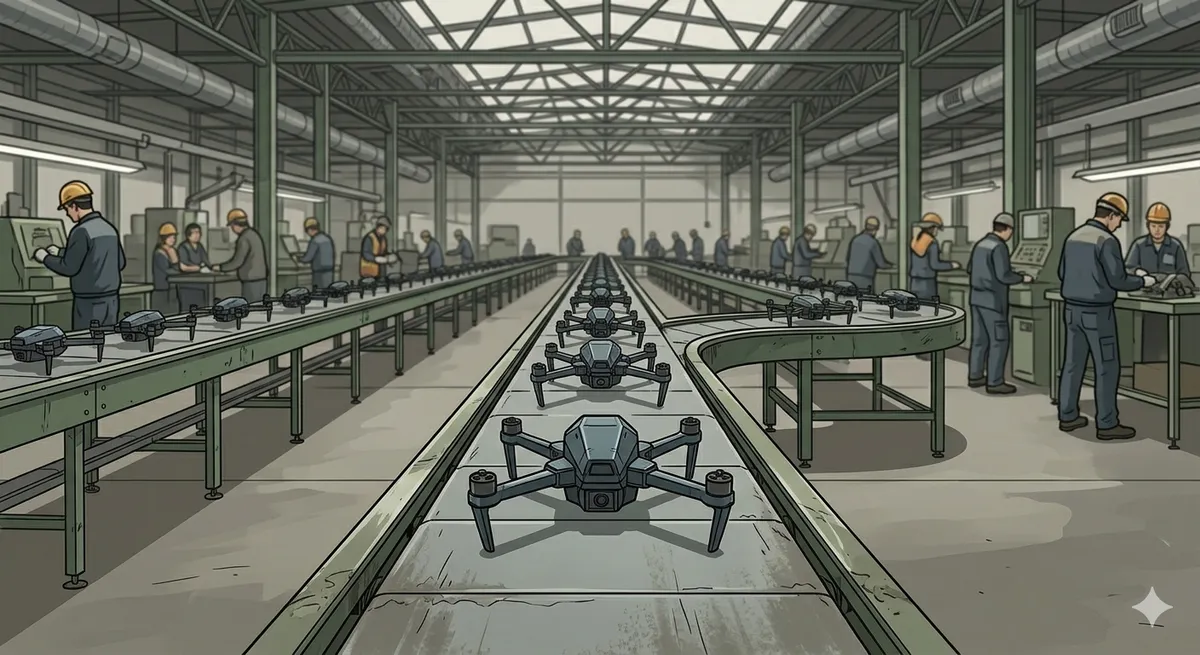
In a factory in Mildenhall, Suffolk, a small town whose main claim to fame is an American air base and a questionable number of roundabouts, workers are assembling combat drones designed by Ukrainian engineers. The drones are called Octopus, which is the sort of name a country gives its weapons when it has stopped worrying about the brand and started worrying about the body count. Each one costs less than a tenth of what it destroys, the British government is turning out about 2,000 a month, and this is the first serial production of a Ukrainian combat drone inside a NATO country, a sentence that would have read like satire three years ago. The technology transfer runs in the direction nobody in Washington expected. The country NATO was supposed to be rescuing is designing the weapons. The rescuers are working the assembly line.
In 2022, Ukraine's armed forces ran on American artillery shells and HIMARS rockets the way a hospital patient runs on an IV drip, and every country in Europe understood, with the quiet dread of someone who has noticed their landlord measuring the front door, that the United States could yank the line whenever it wanted. Not that Europe liked Trump, or trusted him, or agreed with a single syllable of his NATO freeloading routine, but the cost of saying so was a Ukrainian army running dry in weeks. You can hate the man holding the oxygen tank. You do not, as a general rule, tell him to go to hell.
And then, while the diplomats were staging photo opportunities and the think tanks were churning out position papers with titles like "Sustaining Transatlantic Cohesion in an Era of Uncertainty," Ukrainian engineers in workshops that smelled of solder and adrenaline quietly ate the leverage.
A country that grabbed itself by the collar
Before the full-scale invasion, Ukraine had seven drone manufacturers. It now has something like 500, a figure that sounds like a misprint until you remember that a country whose survival depends on building a weapons industry will repurpose a car battery factory before the insurance paperwork clears. Production went from functionally nothing in 2022 to 800,000 in 2023 to 2.2 million in 2024, the kind of year-on-year doubling that would make a Silicon Valley investor weep into their oat milk, except nobody involved was thinking about growth curves, they were thinking about not being dead by spring.
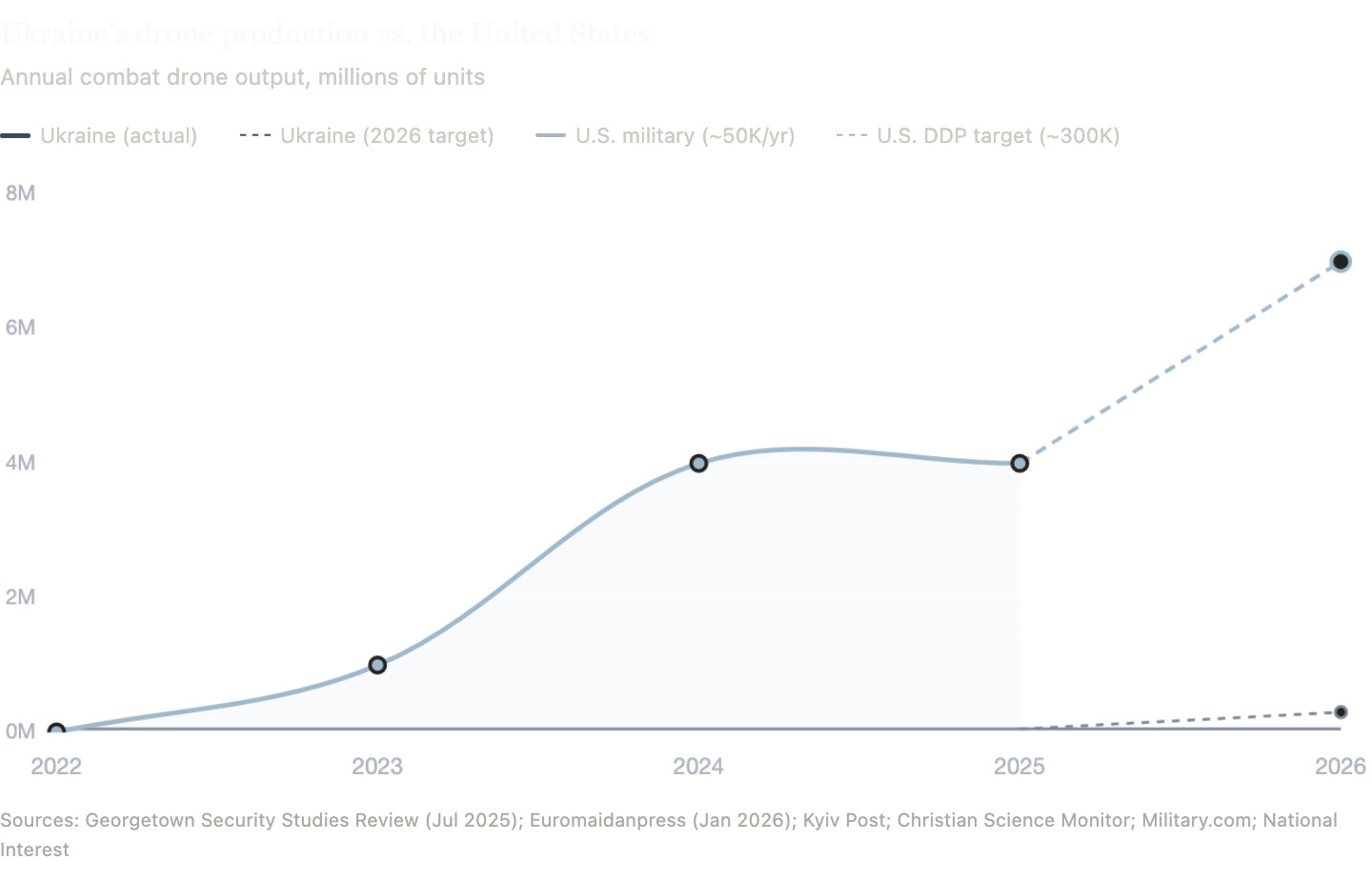
Zelensky told reporters in early 2025 that annual capacity had hit 4 million. The deputy defense minister told a NATO conference in January 2026 that the target for the year was 7 million. Put that next to the American number and it starts to feel surreal: the United States, whose military budget could purchase Denmark six times over and still have change for Greenland, makes roughly 50,000 combat drones a year. Ukraine's output exceeds the combined total of every NATO member, which is either a staggering indictment of Western procurement or the most expensive compliment the Pentagon has ever received.
None of this happened because somebody gave a TED talk about disruption. It happened because soldiers were dying faster than the supply chain could protect them, because artillery support was stuck in a congressional appropriations fight or sitting in a German warehouse on a shipping schedule that moved with the urgency of a pension fund, and because a $500 drone strapped to a grenade did roughly the same job as a $100,000 shell if you were willing to fly it into the thing yourself. Ukraine's defense industry revenue went from $1 billion in 2022 to $9 billion in 2024, the kind of growth that in any other context would get someone a magazine cover but here just meant slightly fewer people froze to death in trenches waiting for equipment that had been promised six months ago.
The innovation was real, the speed was extraordinary, but it was born out of desperation so complete that the alternative to inventing something was dying, and it was paid for in lives that do not show up in the production statistics. Latvia's intelligence services estimated that drones now cause up to 80% of battlefield casualties on both sides, and Ukrainian commanders say strikes behind enemy lines shattered Russian artillery logistics so badly the shelling dropped off, which sounds like propaganda until you look at where Ukraine's weapons budget actually goes now.
Where the money went
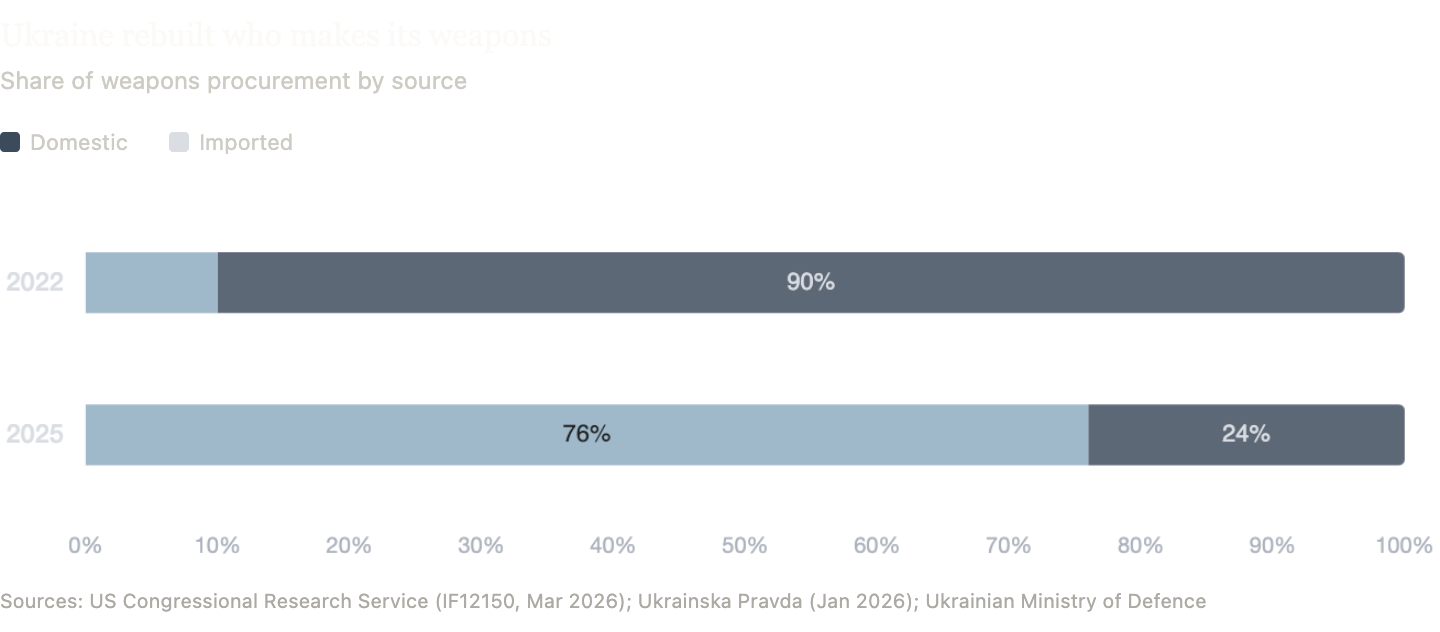
In 2022, less than 10% of Ukraine's weapons procurement was domestic, a number that basically translates to "we bought everything from someone else and hoped they wouldn't stop selling." By 2025 it was 76%, confirmed by the US Congressional Research Service, the kind of source that is not in the business of exaggerating to make anyone feel better. Every drone used in offensive operations against Russian targets is now Ukrainian-made, and in the space of three years the country rebuilt the load-bearing wall of its military while the old one, American-made, was still theoretically holding the roof up, except the Americans had started pulling bricks out without mentioning how many were left.
Trump cut new aid allocations to near zero. The defense bill included $400 million for Ukraine over two years, compared to $14 billion the year before, which is the budgetary equivalent of replacing someone's salary with a book token and a pat on the back.
Researchers from West Point who had actually visited the frontlines, rather than reading about them from an office in Georgetown, put it with the understatement only military academics can pull off: the absence of American support would not be nearly as catastrophic as it would have been at earlier stages of the war. Which is a long way from "fine." Ukraine still depends on American Patriot air defense, HIMARS rocket artillery, and intelligence that no number of quadcopters can replace, with 86% of its rocket artillery and 82% of its howitzer ammunition still American-made. You cannot swap a Patriot battery for a drone carrying a grenade, and anyone who tells you otherwise is selling something with propellers on it.
But the gap between "Ukraine collapses within months" and "Ukraine bleeds but survives" turns out to be the gap that mattered, because it is the gap that every European leader was quietly calculating when they were deciding how loudly they could afford to tell Washington to get stuffed.
The golf course deal
There is a quote from October 2025 that deserves to be printed, framed, and hung in every European foreign ministry. EU Trade Director Sabine Weyand explained that European leaders had accepted a trade deal at Trump's golf course in Turnberry, Scotland, because if they had not, the United States would have walked away from the security partnership altogether. A former Biden advisor confirmed to Time that European leaders had said the quiet part directly: they were too dependent on American military support to risk annoying the man providing it. The word for that arrangement is not alliance. The word for that is a protection racket with better catering.
The same dynamic runs domestically, where institutions built to serve the public have been quietly redirected toward concentrated interests, with the same pattern of costs socialized and benefits privatized.
The word for that arrangement is not alliance. The word for that is a protection racket with better catering.
You swallow the tariffs, smile at the golf course, draft your communiqués in language the White House won't find threatening, and in exchange the ammunition keeps flowing east and Ukraine doesn't collapse on your doorstep. Everyone knew it was a rotten deal. But when your neighbor's house is on fire and only one person on the street owns a hose, you don't start an argument about water pressure.
Then the neighbor built their own hose. Then they sold the design to the British, who opened a factory in Suffolk. Then the Germans set up an automated drone production line, the EU wrote a check for €90 billion, European military spending jumped 14% in a single year, the sharpest rise since the Cold War, Germany blew past the 2% of GDP threshold for the first time since reunification, and somewhere between the golf course in Turnberry and the Greenland tariffs the whole arrangement collapsed like a tent in a gale, except nobody inside seemed particularly sorry to see it go.
When Trump slapped tariffs on eight European countries over Greenland, France reached for the Anti-Coercion Instrument, the EU's heaviest economic weapon, the one behind the glass marked "break only if an American president has lost his mind." Macron went on television to say that no threat or intimidation would move them. European leaders rejected Trump's peace plan as a draft. The UK and France offered Ukraine security guarantees without bothering to ask Washington's permission.
The drones did not cause any of this anger, the anger has a dozen fathers and most of them have Trump's signature on them. What the drones did was change the price of acting on it. The provocation went up, the cost of resistance came down, and that is when the math changed.
Scar tissue
Trump still holds cards, big ones: NATO membership, intelligence sharing, the dollar, the sprawling architecture of American soft power that took seventy years to build. But there is a design flaw in how he plays them that nobody in the White House has spotted: coercive leverage, once deployed, teaches the other party to build around it. You can threaten to cut off the ammunition once. You cannot threaten it a second time, because the first time you did it they went home and built a drone factory.
Denmark chose the Franco-Italian SAMP/T over the American Patriot. Canada joined the EU's joint procurement fund and announced that the era of sending 70 cents of every military dollar to Washington was finished. Ukraine built a defense industry from nothing to $12 billion in four years, the kind of timeline that should make American defense contractors nervous in a way no congressional hearing ever will. A drone factory in Mildenhall does not close when the next American president shows up making reassuring noises about alliances. An automated production line in Germany does not get mothballed because the next Secretary of State is friendlier on the phone. These are 20-year industrial bets that will outlast every politician currently drawing a salary on any continent, all made because one man played the leverage card so crudely and so often that everybody he was trying to coerce went home and learned to live without him.
The broader pattern of allied countries hedging structurally against American reliability, rather than waiting for the next election to fix things, is visible across every dimension of transatlantic relations, not just defense procurement.
Ukraine's drone industry did not set out to redraw the transatlantic relationship, it set out to keep soldiers alive when the shells stopped arriving. But a country that learns to fight without American ammunition does not pick up the phone from Washington with quite the same eagerness, and a Europe that watches it happen starts to wonder what, exactly, it has been paying the premium for.
The factory in Mildenhall will keep assembling Octopus drones whether or not the next president can find Ukraine on a map, because that is how adaptations made under pressure work, they stick around long after the crisis is over, like scar tissue that is tougher than the skin it replaced but exists only because something went badly wrong.
Sources
Georgetown Security Studies Review, "A First Point View: Examining Ukraine's Drone Industry," July 30, 2025.
Euromadian Press, "Ukraine aims to build 7 million drones in 2026," January 26, 2026.
Ukrainska Pravda, "Defence industry revenue and domestic procurement data," January 4, 2026.
US Congressional Research Service, Report IF12150, March 2, 2026.
Modern War Institute at West Point, "Frontline Innovation and Domestic Production," March 13, 2025.
CSIS, "How Europe Can Build Ukraine's Future Force," February 27, 2026.
CSIS, "Transatlantic Relations Under Trump: An Uneasy Peace," October 7, 2025.
Time, "Trump, US, and the Transatlantic Alliance," March 2026.
SIPRI, "Global Military Spending Rise Continues," April 27, 2026.
The National Interest, "Have Drones Replaced Artillery in Ukraine?" February 20, 2026.
Kyiv Post, "Drones perform nearly every battlefield function," April 2026.
UK Defence Journal, "UK to mass produce Ukrainian air defence drones," January 25, 2026.