The Democrats Need A Leader, Not A Press Release
The Democrats are falling into the Starmer trap, defining themselves against Trump with no vision of their own. Starmer hit -57 net favorability within 18 months of a 165-seat majority. Meanwhile Mamdani won New York on one word, and Talarico raised $27M with zero corporate PAC money.

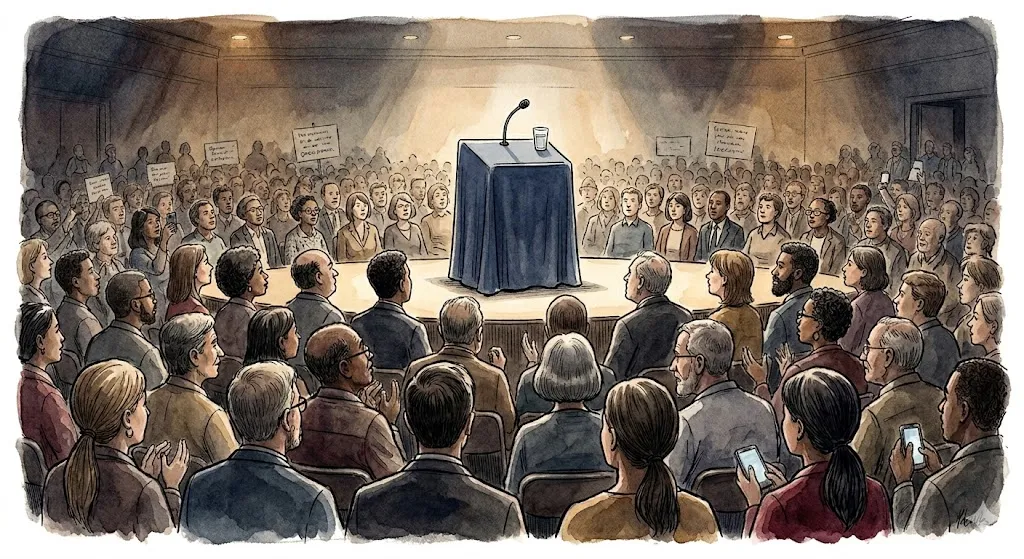
Trump is a lot of things, but one thing I'd argue he is, is a leader. Do I like what he leads? No. Do I like how he leads? No. But does he lead MAGA? Yes.
His approval rating currently sits somewhere between 36% and 41% depending on which poll you look at (Silver Bulletin, CNN, Quinnipiac and RealClearPolitics all have slightly different numbers as of April 2026), and that range has stayed remarkably stable even as he's started a war with Iran, fired his own Attorney General, and tanked consumer confidence in the economy. The number itself is historically low, but the loyalty behind it tells you something. That floor barely moves. He can lose support on the economy, on foreign policy, on gas prices, and his base holds. People don't hold like that for someone they just agree with. They hold like that for someone they follow. And he doesn't just have followers, he has an ecosystem. Fox News, talk radio, podcasts, influencers, Truth Social. MAGA isn't held together by Trump's charisma alone, it's reinforced by a media machine that repeats his message 24 hours a day. The Democrats don't have anything close to that, and it's a problem that goes beyond just picking the right candidate.
But rather than focusing on Trump I want to focus on the Democrats, because this is where they could take a real lesson from Republicans. They need a leader. And whilst they have many who could step up (Bernie, AOC, James Talarico, to name a few) the Democrats are not brave enough at the moment to make that decision. Instead they look to be falling into a trap that has cost them in the last few election cycles. They are defining themselves against Trump. That's it. Not even a vision for what they want the country to be, just a finger pointed at the other guy and a hope that people are angry enough to show up. It's not a platform, it's a reaction.
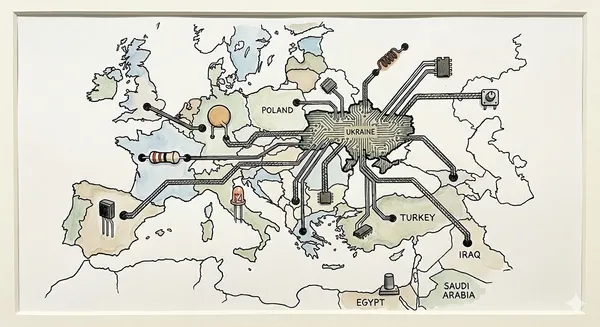
The domestic consequences of this failure have a foreign policy mirror, because allies are already drawing up thirty-year defense plans on the assumption that American institutional weakness is structural, not cyclical.
Before we get into that, it's worth looking across the pond to the UK and to Keir Starmer.
Lessons from Starmer
Keir Starmer is the British Prime Minister and the Leader of the Labour Party. They got rid of the Conservative party after 14 years of rule, and not only that they won with a majority of 165 MPs (they have 404 seats). Now the electoral system they have is ridiculous (not as ridiculous as the electoral college), but even so this is a huge majority. Everyone must have bought into their vision, right?
No.
Labour under Starmer and whilst in opposition styled itself as basically 'we're not the Conservatives'. The Conservatives had gone through scandal after scandal, were genuinely hated by a large portion of the electorate, and Labour said 'we're not them'. And the electorate needed that. After 14 years of Tory rule people were desperate for something different and Labour was standing right there as the obvious alternative. The problem is, 'not being them' wears off very quickly once you're actually in charge and people start asking what you're actually for.
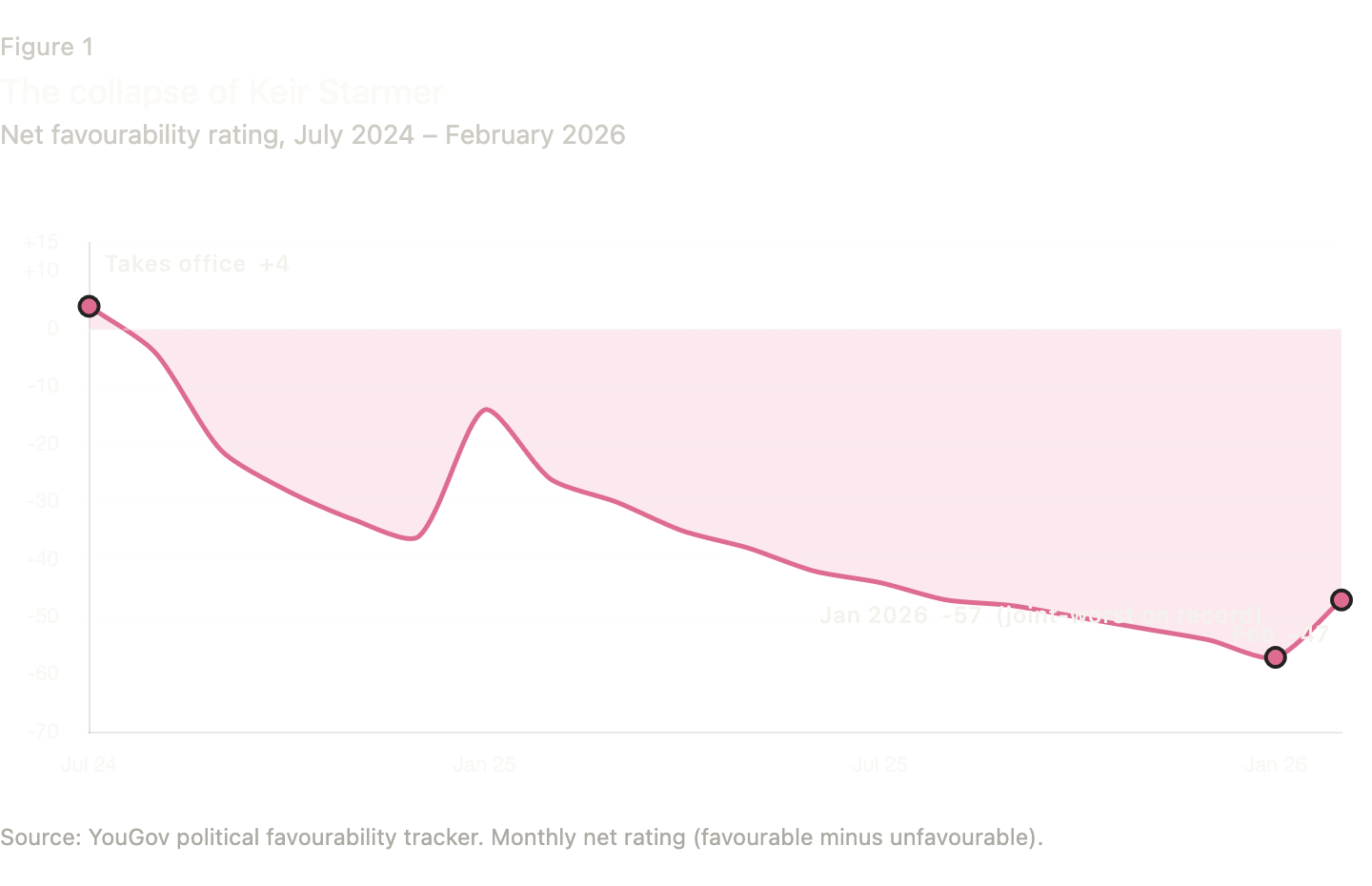
And that is exactly what has happened. Starmer's net favourability hit -57 in January 2026 according to YouGov, putting him level with Rishi Sunak's lowest point and only above Liz Truss, who you may remember lasted 49 days. Over half the country thinks he should step down as Labour leader (Opinium, February 2026). Reform UK, a right wing populist party led by Nigel Farage, is now polling at 30%, with Labour and the Conservatives tied at 18% (Opinium, February 2026). Even among people who actually voted Labour in 2024, opinion on Starmer is basically split down the middle.
Winning without a vision is borrowing against a future you can't pay back, and Labour is learning that lesson in real time.
What a Vision Actually Looks Like
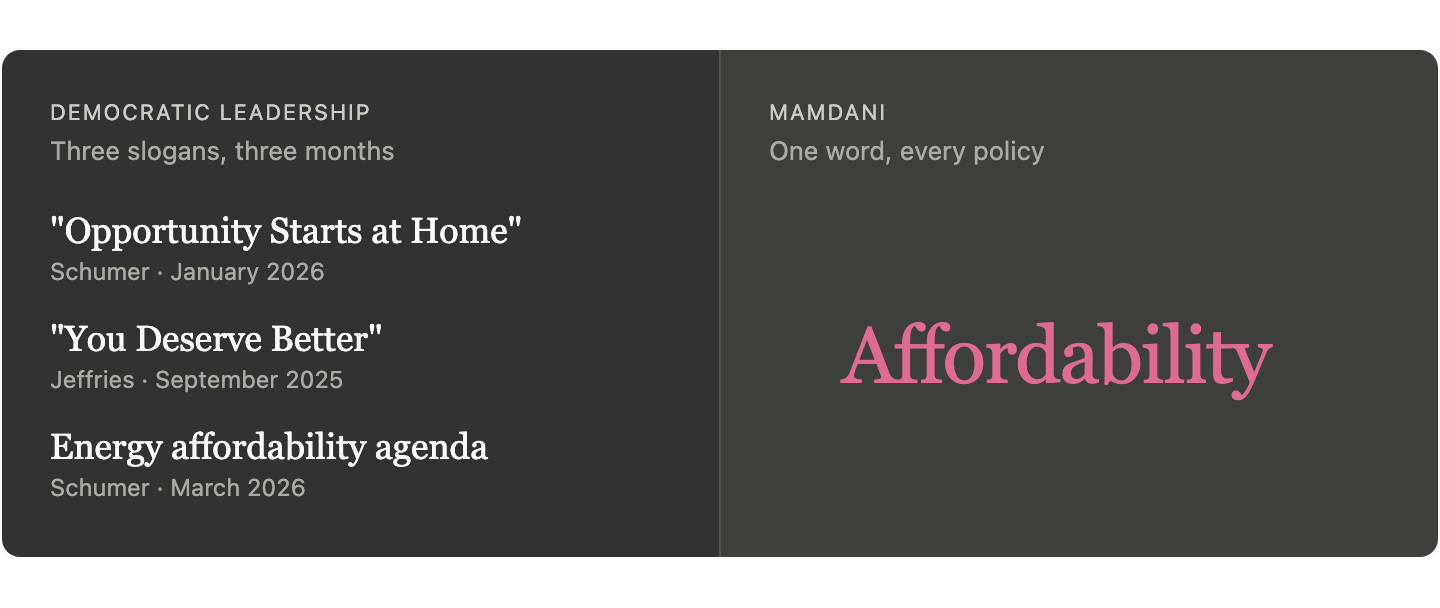
Now, contrast this with Zohran Mamdani in New York City. His campaign tied everything back to a single word: affordability. Not affordability as a talking point or a line in a press release, but affordability as a governing philosophy. The idea that the wealth and opportunity of New York City should benefit the many, not the few. Every policy from transportation to taxation to child care to city-run supermarkets to policing was connected to that central argument. There's obviously a lot more that goes into running a city, but affordability is what people were worried about, and his campaign met them where they were.
His vision was not just 'I'm not Eric Adams'. He did not trash New York City, he did not stand there saying look at how bad it is and only I can fix it. Instead he focused on its strengths, and on opening those strengths to everybody. That's what affordability meant in his framing. Not austerity, but access. He started as a largely unknown progressive socialist running in a city that had just watched its previous mayor get indicted, and he won, because he gave people something to vote for rather than just someone to vote against.
Maya Handa, who ran Mamdani's campaign, said at a Dartmouth Political Union event (April 9, 2026) that what mattered was candidates being able to focus on tangible political platforms, tangible messages that were about what they were going to do for people (Dartmouth News, April 10, 2026).
And yet at a national level, the Democrats have nothing like this. No single idea threading the party together, no narrative that connects policy to people's lives in a way that feels real and consistent. Look at what the party leadership has been doing. In January, Chuck Schumer announces a housing agenda called "Opportunity Starts at Home" (Senate Democratic Leadership, January 16, 2026). In March, he promises a separate energy affordability agenda (E&E News/Politico, March 2026). Somewhere in between, Hakeem Jeffries is running his own "You Deserve Better" messaging (Jeffries press conference, September 2, 2025). That's three different slogans from two different leaders in three months. Compare that to Mamdani. One word. Every policy. Every speech. That's the difference between a relatable vision, and a box ticking press release that is forgotten about a few minutes later.
Back to the Democrats
The Democrats have a real opportunity in 2026 and 2028 to actually shift the country forward. Provisional indications suggest a potential blue wave, the kind of midterm swing that tends to happen when the party in power is struggling. And yet what is the Democrats' message so far? What are they united behind?
They have no economic message, and if they don't get one, they're not going to win. - Jim Messina · Campaign manager, Obama 2012
Jim Messina, who managed Obama's 2012 reelection campaign, was blunt about this at the Third Way conference in South Carolina (Fortune/AP, March 3, 2026). His argument was that Trump's unpopularity will hand Democrats wins in 2026 by default. And here's the thing, he's probably right about that. But the uplift from 2026 won't last, because if people vote for the opposition rather than for a vision, they can just as easily vote for a different opposition next time. Voters who choose you because they're angry at the other guy don't owe you anything in 2028. But voters who choose you because they believe in what you're building are far more likely to give that vision time to play out. When Messina was asked to give Democrats the brutal truth, he said they have no economic message, and if they don't get one, they're not going to win (Fortune/AP, March 3, 2026). Now, Messina is a moderate, and his framing carefully stays within what the centrist wing of the party finds comfortable. But even from that position the diagnosis is the same. No message, no vision, no plan beyond "Trump is bad."
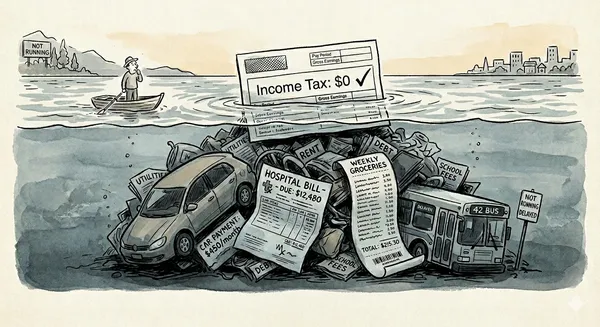
The economic message they are missing is sitting in plain sight, because corporations are using AI to compress wages across the entire economy while posting record profits, and neither party has a plan for it.
That is exactly the Starmer trap. And the Democrats are walking right into it.
The frustration isn't just coming from pundits and strategists, it's coming from Democratic voters themselves. A Reuters/Ipsos poll from June 2025 found that 62% of self-identified Democrats believe the party's leadership should be replaced with new people (Reuters/Ipsos, June 19, 2025, surveying 4,258 people including 1,293 Democrats). The same poll found a deep disconnect between what Democratic voters say their priorities are and the issues they believe party leaders actually care about. People wanted the party focused on their day-to-day needs, on affordability, on kitchen table economics. They felt their leaders were not focused on helping families make ends meet.
The data on how government spending has been redirected upward over four decades, with 23% of OECD transfers reaching the poorest fifth and 20% reaching the richest, is the foundation of an economic platform that writes itself if anyone is willing to read it.
And yet here is the problem that nobody in the party leadership seems willing to talk about. The reason the obvious move (unite behind a populist economic message) keeps not happening isn't just a failure of imagination. It's structural. Schumer and Jeffries depend on donor networks that are actively hostile to the kind of economic populism that Mamdani and Bernie represent. The moderate wing isn't just failing to read the room, they're reading a different room, one full of the people who fund their campaigns. That tension is why the party keeps producing three slogans instead of one vision, and why 62% of its own voters want new leadership.
Because on the other side of the party, something is clearly working. Bernie and AOC drew over 260,000 people to their Fighting Oligarchy tour across 15 states in 2025, bigger than any events being held by Democrats at the time, and bigger than any crowd from either of Bernie's presidential runs (Wikipedia, sourced from rally attendance figures and Politico reporting). James Talarico, a former public school teacher and progressive running for Senate in Texas, just raised $27 million in a single quarter with 97% of donations at $100 or less and zero from corporate PACs (Texas Tribune, April 15, 2026). When the FCC blocked Stephen Colbert from airing an interview with him, he raised $2.5 million in 24 hours (Dallas Morning News). He won his primary against a sitting congresswoman. These people aren't just saying the right things, they're proving that a clear progressive message, tied to real people's lives, actually generates the energy and the money that the party claims it needs.
Without a united front behind a common vision, without a leader who can thread all of this together the way Mamdani threaded affordability through every policy in New York, this is going to be another missed opportunity. The conditions are there. The energy is there. The anger at Trump is certainly there. But anger at what the other side is doing has never been enough on its own to build something lasting. Starmer proved that. And if the Democrats win 2026 on anti-Trump sentiment alone, which they very well might, what then? Do they have any mandate to actually do anything? Or do they end up exactly where Labour is now, in power but paralysed, watching their support bleed away because nobody can explain what they stand for?
The Democrats need to learn from Starmer before they repeat him.
Sources referenced throughout:
- Trump approval ratings: Silver Bulletin (April 15, 2026), CNN/SSRS poll (April 1, 2026), AOL/Ballotpedia/RealClearPolitics (April 16, 2026)
- Starmer favourability: YouGov political favourability ratings (January 2026, February 2026)
- Starmer should resign: Opinium voting intention poll (February 25, 2026)
- Reform UK polling: Opinium voting intention poll (February 25, 2026)
- Maya Handa quote: Dartmouth News, "What Do Democrats Need to Do in 2026 and 2028?" (April 10, 2026)
- Jim Messina quotes: Fortune/Associated Press, "Obama's former campaign manager has a 'brutal truth' for Democrats" (March 3, 2026). Speaking at Third Way conference in South Carolina.
- Schumer "Opportunity Starts at Home": Senate Democratic Leadership transcript (January 16, 2026)
- Schumer energy affordability agenda: E&E News/Politico (March 2026)
- Jeffries "You Deserve Better": Jeffries press conference transcript (September 2, 2025)
- Reuters/Ipsos poll (62% want new leadership): Reuters, June 19, 2025. Survey of 4,258 people nationwide, including 1,293 Democrats, margin of error approx. 3 percentage points.
- Fighting Oligarchy tour attendance: Wikipedia, sourced from rally organisers and news reports. Politico described rallies as "bigger than any other events currently being held by Democrats" (March 26, 2025).
- Talarico fundraising ($27M, 97% small-dollar, no corporate PACs): Texas Tribune (April 15, 2026), Axios Austin (April 15, 2026), Houston Public Media (April 15, 2026)
- Talarico/FCC/Colbert: Dallas Morning News, Wikipedia, citing Colbert's February 2026 on-air statement. Raised $2.5M in 24 hours following the incident.
- Talarico primary win: Defeated U.S. Rep. Jasmine Crockett in March 3, 2026 Democratic primary.